

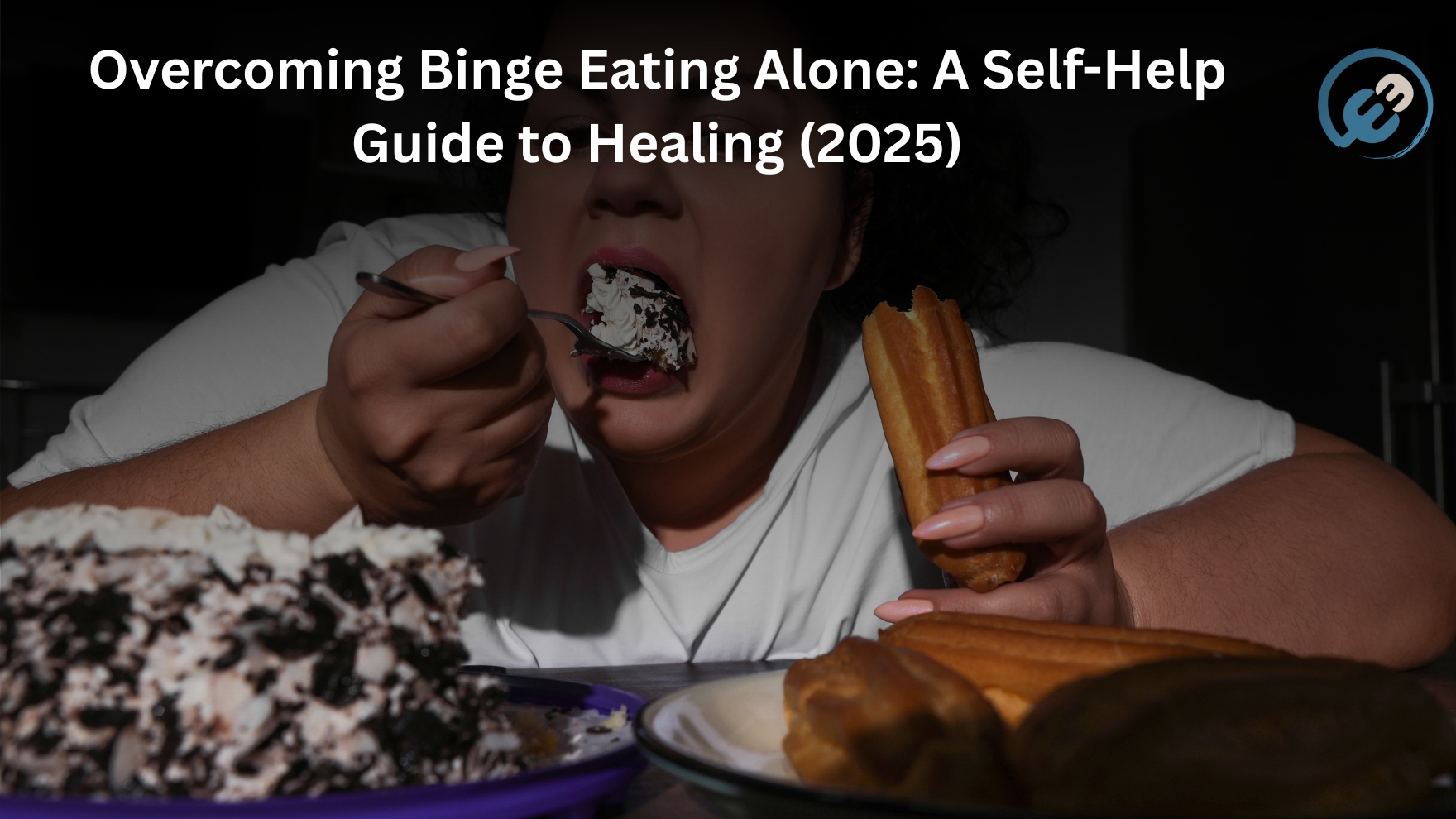
It can feel almost impossible to talk about.
The food. The secrecy. The silence afterward.
Maybe it happens late at night. Maybe it happens in the car.
Maybe it looks like control from the outside — but inside, you feel like you’re spiraling.
And when you’re trying to recover on your own, that spiral can feel even more isolating.
No one sees the effort it takes just to not go back to the pantry.
No one sees the war happening in your mind.
And even when you do stop for a while… the shame doesn’t always stop with it.
If this is you — this article is for you.
You don’t need to be perfect.
You don’t even need to be “ready.”
You just need a starting point rooted in something deeper than willpower.
Why It’s So Hard to Stop Binge Eating Alone

Let’s start with truth: you are not weak.
The urge to binge is not random. It’s not laziness. It’s not failure.
It’s your nervous system trying to protect you — from overwhelm, from emotion, from emptiness.
Many people who binge alone carry a history of:
- High-functioning perfectionism
- Early emotional neglect or inconsistency
- Pressure to always hold it together
- Cultural messaging that says thin = good, control = worth
This isn’t just a “bad habit.”
It’s a coping strategy.
According to a 2020 review in the International Journal of Eating Disorders, binge eating often correlates with elevated emotional distress, alexithymia (difficulty identifying emotions), and insecure attachment styles.
So no — you’re not broken. You’re responding to pain in the only way you learned how.
And that means: healing is possible.
Even if you’re walking this path alone right now.
The Inner Landscape of Binge Eating: What’s Really Going On?
If binge eating is a response, what’s it responding to?
Here are some common internal states that often precede a binge:
- Disconnection — from your body, emotions, needs
- Overwhelm — especially emotional overload
- Deprivation — physical (like restriction), emotional (like loneliness)
- Shame — often from old beliefs like “I should be better than this”
- Exhaustion — nervous system collapse, not just tiredness
When we explore this with clients, many realize that food was never the enemy.
It was the only thing that consistently showed up.
👉 For a deeper look at these root causes, check out the Enlighten Eats Course — a comprehensive, compassionate program that explores every layer of healing.
5 Self-Guided Practices to Support Healing from Binge Eating

1. Start with Self-Attunement, Not Restriction
Instead of “I need to stop this”, try:
“What am I feeling right before I reach for food?”
This tiny shift moves you from control to curiosity — and opens the door to healing.
Try this:
Before you eat, pause. Place one hand on your belly, one on your heart. Ask: “Is this physical hunger, emotional hunger, or something else?”
Even if you still eat — you’ve planted a seed of awareness.
2. Use a Journal, But Not for Calories
Traditional food tracking can trigger shame. Instead, use a mindful meal journal to explore:
- Time and place
- Emotions before eating
- Sensations in the body
- What the food gave you (comfort, escape, numbness?)
- How you feel afterward (gently — no blame)
📝 Our free journaling app is designed for exactly this: compassionate, pressure-free reflection
3. Soothe Your System Before You “Solve” the Urge
Many binge urges come from nervous system dysregulation — when your body goes into a state of fight, flight, or freeze.
When this happens, logic won’t help.
Soothing will.
Try this 2-minute reset:
- Sit down, feet on the floor
- Look around — name 5 things you see
- Inhale for 4 seconds, exhale for 6
- Touch something soft — a blanket, your own arm
- Whisper to yourself: “It’s okay to feel this way.”
These are not “silly” practices.
They are biological interventions for an overwhelmed system.
4. Reframe “Failure” as Feedback
You will slip. You will have moments where you binge again. This does not erase your progress.
Every episode contains information.
Ask yourself:
- What was happening before the binge?
- What did I actually need in that moment?
- How might I meet that need differently next time?
You don’t start over. You continue forward — with more insight.
5. Create Micro-Moments of Self-Compassion
Recovery isn’t made in huge declarations.
It’s built in tiny moments where you stay with yourself.
Moments like:
- Choosing to breathe instead of binge — even if it’s just once
- Crying and not numbing it with food
- Saying “I’m here with you” in the mirror after a hard night
These are holy moments.
They are how the pattern begins to soften
Is It Really Possible to Heal Without Help?

Yes — and also, it’s okay to not want to do it alone.
Many people begin the journey solo. But over time, it helps to have support.
That might look like:
- A support group
- A therapist or coach
- Even a trusted friend who knows the truth
Our coaching offer exists for this very reason — not to fix you, but to walk beside you as you remember who you are beneath the pattern.
You’re not too far gone.
You’re right on time.
Final Thoughts: You Are Not Alone (Even If It Feels That Way)
Overcoming binge eating alone is hard. But not impossible.
With tenderness, reflection, and nervous system safety, the cycle can unwind.
Here’s what I hope you remember:
- You are not broken — you are responding
- Food is not the enemy — shame is
- Your body can learn a new way — with love, not force
🧡 Take our free quiz to understand your food story
📱 Or try the Mindful Meal Journal App — your quiet space for healing
🌱 And when you’re ready, coaching support is here to walk with you
You are worth it. Even — and especially — on the days you forget.