
Why do we turn to food, even when we know it hurts?
It’s a question so many of us sit with—standing in the kitchen, staring down an empty box of cookies, wondering why am I like this? You might feel trapped in the same cycle: relief, shame, resolve… and then, the pattern repeats.
Here’s something to hold onto:
You are not broken.
Binge eating isn’t a character flaw. As research from the National Eating Disorders Association (NEDA) explains, binge eating often develops as a way to cope with emotional pain, trauma, or unmet needs source. Food becomes comfort, rebellion, safety, and sometimes even identity.
This guide will help you view binge eating through a developmental lens—showing how your relationship with food evolves as you do. Each stage of healing brings its own challenges and next steps.
If you’re curious where you land in your journey, take our free Eating Enlightenment Quiz for gentle, personalized insight: Take the Quiz ».

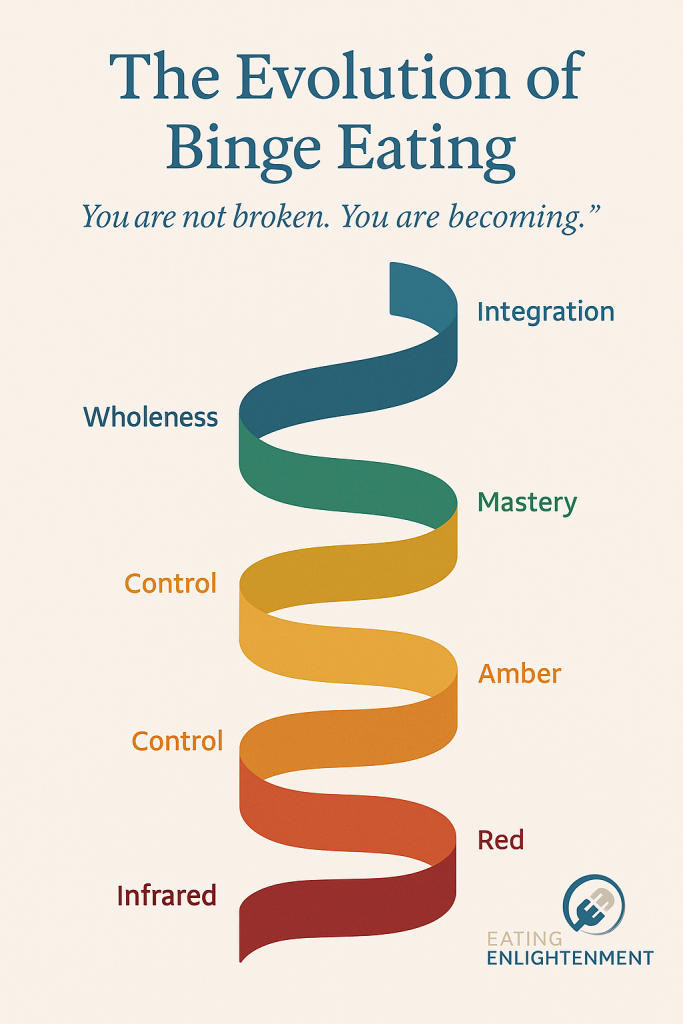
The Evolution of Binge Eating: You Are Not Broken—You Are Becoming
It’s easy to think: I’ve tried everything—why am I still stuck? You may have cycled through diets, intuitive eating, therapy, and wellness plans… yet something still feels unresolved.
What most guides don’t tell you is this:
Your relationship with food changes as you grow. Different life stages bring new emotional and psychological needs, and each stage can reshape why you binge.
Consider Maya.
As a child, Maya hoarded food in secret—a reaction to scarcity and emotional neglect. As a teen, she binged rebelliously, pushing back against controlling diet talk at home. In her 20s, she became a perfectionist “clean eater,” tracking every bite. In her 30s, she stepped into intuitive eating but still wrestled with occasional binges when life felt overwhelming.
Maya’s story, like yours, is layered. Every stage brought a new logic—and required a new kind of healing.

Stage 1: Infrared & Magenta—Survival, Safety, and the First Food Bonds
Problem:
Binge eating as survival: hoarding food, secretive eating, or numbing overwhelming emotions.
Cause:
Food serves primal needs—security, comfort, and soothing—especially in chaotic or neglectful environments. Studies show that early food insecurity can lead to disordered eating later in life source.
Example:
A child sneaks snacks after dinner because meals are unreliable—or eats to quiet scary feelings.
Want to explore your own food roots with curiosity? Download the Eating Enlightenment Journal App for daily reflection and grounding: Get the App »
Stage 2: Red—Power, Rebellion, and Emotional Fire
Problem:
Binge eating as defiance or emotional release.
Cause:
Bingeing becomes a way to reclaim autonomy and push back against external control—a pattern recognized in Dialectical Behavior Therapy (DBT) frameworks source.
Example:
A teen binges after being forced onto a strict diet, driven by rage and the need to feel in control.
Learn how emotional empowerment can be part of healing in our Enlighten Eats Course: Explore the Course »
Stage 3: Amber—Rules, Righteousness, and the Cage of Control
Problem:
Rigid diet rules and cycles of restriction-binge-shame.
Cause:
Seeking safety through external rules, reinforced by cultural and family beliefs. Research in the Journal of Eating Disorders shows how black-and-white food rules increase binge risk source.
Example:
A person restricts carbs religiously, then binges and punishes themselves after slipping.
Stage 4: Orange—Logic, Mastery, and the Search for the Perfect Plan
Problem:
Obsessing over calorie counting, nutrition science, and health tracking.
Cause:
Belief that precision and knowledge will end the struggle—often disconnecting people from intuitive cues. The American Psychological Association notes that over-reliance on food tracking can worsen disordered patterns source.
Example:
A health-focused person tracks every meal but still binges at night, confused by their own behavior.
If you’re seeking balance between knowledge and intuition, the Eating Enlightenment Journal App offers simple mindful eating prompts: Start Journaling »
Stage 5: Green—Overwhelm, Choice Fatigue, and the Quest for Wholeness
Problem:
Overwhelmed by too many healing methods—mindfulness, somatics, therapy, intuitive eating.
Cause:
A deep craving for authenticity, but confusion over which path is best. This mirrors what’s described in Health at Every Size® frameworks—where well-meaning efforts can stall without clarity source.
Example:
Someone joins three different support groups, reads countless books, but feels more scattered than soothed.
Stage 6: Teal & Beyond—Blocks Beyond the Self: Facing Systemic Realities
Problem:
Even after deep personal healing, systemic barriers (diet culture, access to care) persist.
Cause:
An awareness that healing is also social and systemic. Research from the World Health Organization links social determinants—like stigma and healthcare access—to sustained eating struggles source.
Example:
A person feels at peace with food but struggles to maintain it at work, where diet culture dominates.
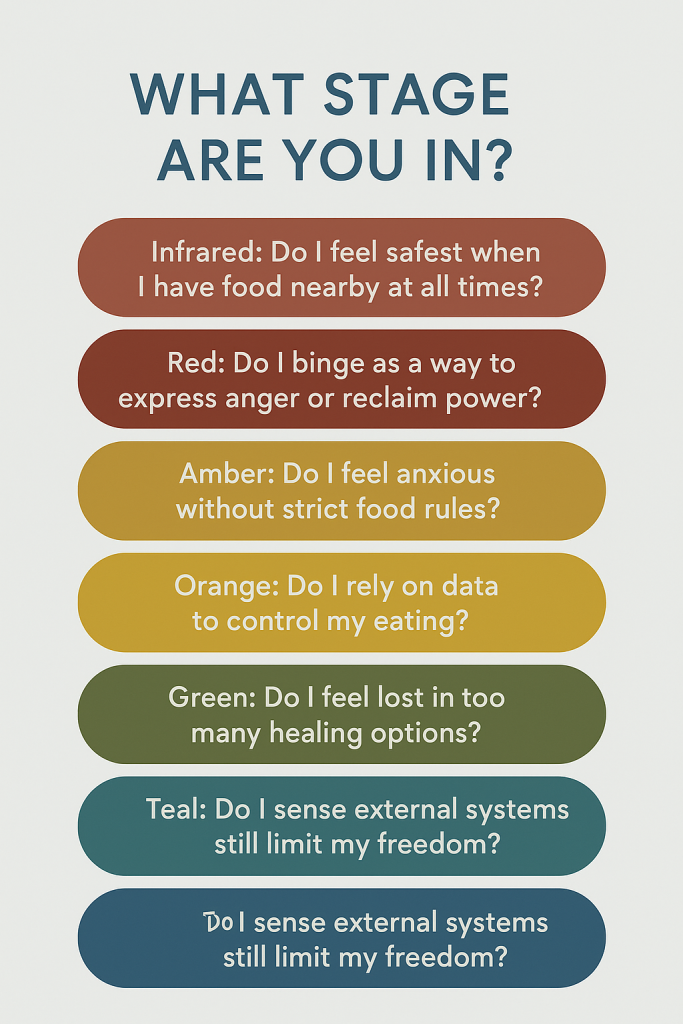
What Stage Are You In? A Self-Reflection Roadmap
- Infrared: “Do I feel safest when I have food nearby at all times?”
- Red: “Do I binge as a way to express anger or reclaim power?”
- Amber: “Do I feel anxious without strict food rules?”
- Orange: “Do I rely on data to control my eating?”
- Green: “Do I feel lost in too many healing options?”
- Teal: “Do I sense external systems still limit my freedom?”
💡 Curious where you are? Take our Eating Enlightenment Quiz to discover your next step: Take the Quiz »
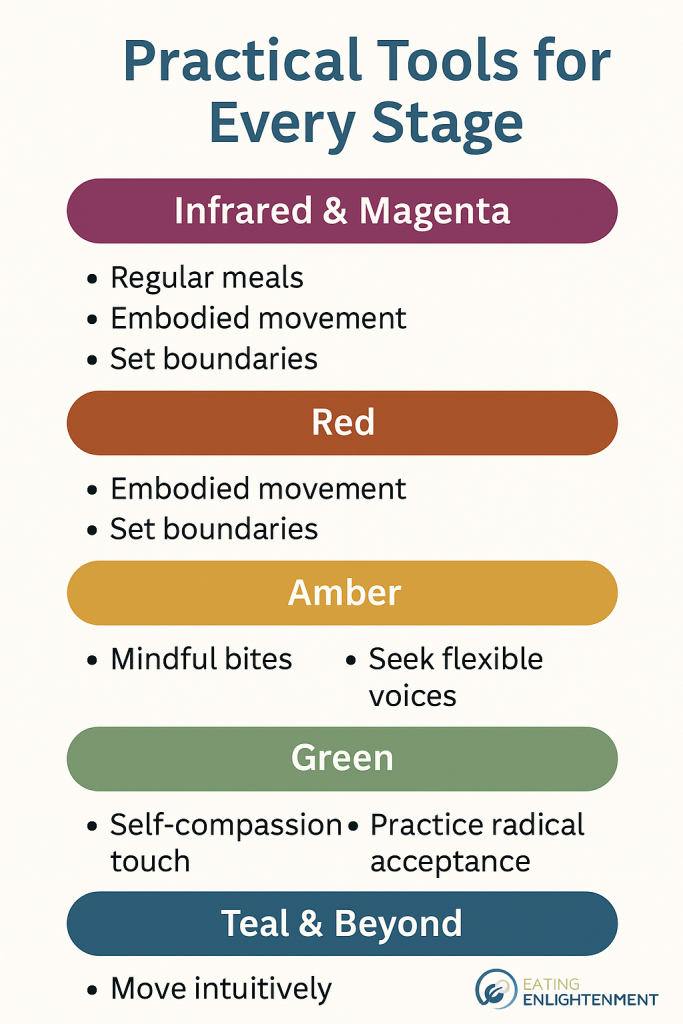
Healing in Action—Practical Steps for Each Stage
Infrared & Magenta—Creating Safety and Nurturance
Body-Based Steps:
- Establish regular, predictable meals.
- Use grounding practices (deep breathing, touchstones) before/after meals.
- Create physical safety cues: cozy blankets, warm baths, soothing spaces.
Mind/Emotion Steps:
- Journal: “What did I need that I didn’t get?”
- Notice emotional eating urges—gently, without judgment.
Structural Steps:
- Access community resources (e.g., food banks, meal-share groups).
- Build tiny safe connections (even brief social exchanges).
Red—Empowerment Through Healthy Boundaries
Body-Based Steps:
- Explore empowering movement: martial arts, power walking, dance.
- Pause to feel cravings physically: where does the “urge surge” land in your body?
Mind/Emotion Steps:
- Track rebellious eating triggers (CBT-inspired).
- Release anger safely: unsent letters, shouting into a pillow.
Relational Steps:
- Practice saying “no” once a week.
- Affirm: “I am allowed to choose my nourishment.”
Amber—Easing Rigidity and Expanding Flexibility
Body-Based Steps:
- Introduce one “forbidden” food in a calm setting.
- Stay present with the discomfort of breaking a rule.
Mind/Emotion Steps:
- Catch all-or-nothing thoughts: “What rule am I clinging to?”
- Journal: “What would safety feel like without strict rules?”
Relational Steps:
- Seek role models who model balance.
- Question inherited food beliefs with gentle curiosity.
Orange—Integrating Knowledge and Embodiment
Body-Based Steps:
- Practice hunger/fullness check-ins.
- Do body scans before and after meals.
Mind/Emotion Steps:
- Journal: “What is my body telling me that my mind resists?”
- Pair nutrition knowledge with self-compassion.
Tools:
- Mindful eating (5 senses).
- CBT worksheets for perfectionism.
Green—Deepening Self-Compassion and Emotional Healing
Body-Based Steps:
- Track emotional/somatic sensations when eating.
- Use self-compassionate touch (hand on heart).
Mind/Emotion Steps:
- Create a mantra: “It makes sense I feel this way.”
- Practice radical acceptance of setbacks.
Relational Steps:
- Join healing groups or therapy communities.
- Journal: “Where do I over-give? How can I return to myself?”
Teal & Beyond—Trusting Integrated Wisdom
Body-Based Steps:
- Move intuitively: walk, stretch, dance as feels right.
- Tune into subtle hunger and satiety without “fixing.”
Mind/Emotion Steps:
- Journal: “What deeper need is showing up?”
- Let go of food labels—notice the felt sense instead.
Relational & Structural Steps:
- Mentor others if ready.
- Engage in advocacy to challenge diet culture.
Optional: Turquoise & Ultra Violet—Living in Peace
- Practice gratitude rituals.
- Celebrate food as sacred and joyful.
There Is Nothing Broken in You
You are evolving, step by step.
Your struggles with food are not proof of failure—they are proof of your humanness, your resilience, your deep capacity for growth.
Healing is not linear. It is layered, cyclical, and wise. Each stage of your journey has brought you to this moment of deeper understanding and care.
If you’re ready to explore your next step, we invite you to take our free quiz and check out our journaling app for gentle, daily support.
You are already on your way.