

Sometimes food feels like the only safe place in the world.
Whether it’s late at night with a spoon in hand, or a familiar cycle of secrecy, guilt, and hunger, binge eating can feel like a private battle — one filled with shame, confusion, and isolation. Maybe you’ve wondered why you can’t “just stop.” Maybe you’ve tried everything: diets, willpower, even punishment.
But what if the truth is: your behavior makes sense?
In this article, you’ll uncover 10 surprising truths about binge eating disorder (BED) that go far beyond calories, willpower, or self-control. These insights are drawn from neuroscience, psychology, and thousands of lived experiences — including our community at Eating Enlightenment.
If you’re looking for a healing path that’s compassionate, trauma-informed, and free of shame, you’re in the right place.
Curious about your relationship with food?
Our free quiz can offer some gentle insight.
1. Binge Eating Disorder Is the Most Common Eating Disorder — Yet Often Misunderstood
BED affects more people than anorexia and bulimia combined, yet it remains wildly underdiagnosed.
One reason? Many people assume that if someone lives in a larger body or doesn’t purge, they must not have an eating disorder. But BED doesn’t have a “look.” It lives in the hidden spaces of shame and silence.
Key Insight:
BED is not about a lack of discipline — it’s a trauma-informed response to overwhelm and unmet needs.
📚 According to the National Eating Disorders Association, BED affects an estimated 2.8 million people in the U.S. alone (Hudson et al., 2007).
2. BED Is Deeply Tied to the Nervous System — Not Just Willpower

Have you ever felt like you’re on autopilot during a binge? Like your body is moving without your permission?
That’s not weakness. That’s nervous system dysregulation.
When we’ve experienced chronic stress, trauma, or emotional neglect, our bodies may enter a freeze or collapse state — followed by a desperate reach for comfort, often through food.
Signs of Nervous System Involvement:
- Emotional numbness followed by intense cravings
- Cycles of bingeing after stress or social interaction
- A felt sense of disconnection during or after eating
At Eating Enlightenment, we often work with clients to gently rewire these patterns using mindfulness, breath, and co-regulation.
💡 If you’re curious, our Mindful Meal Journal App can help you track not just what you eat, but how you feel before and after.
3. Bingeing Isn’t About Food — It’s About Emotional Safety
Behind every binge, there’s usually a story.
Maybe you grew up in a home where emotions weren’t safe. Maybe food was the only “friend” that didn’t judge you, abandon you, or ask you to perform.
Food becomes a regulator, a refuge. And when your body has been conditioned to associate food with safety, it makes sense that you’d return to it — again and again.
What this tells us:
Healing doesn’t come from food rules. It comes from creating safety in your body, in your relationships, and in your life.
4. Dieting Often Triggers — Not Heals — Binge Eating

This might be the most surprising truth of all:
Restrictive dieting is one of the leading causes of binge eating.
When we restrict — whether it’s calories, carbs, or entire food groups — our bodies respond with primal hunger. Add in perfectionism, shame, and societal pressure, and it’s a recipe for the binge-restrict cycle.
Watch for These Red Flags:
- “Cheat meals” that spiral into days of guilt
- Obsessing over “clean eating” but secretly bingeing
- Using exercise to “make up” for eating
🧠 Research has shown that caloric restriction significantly increases the risk of binge eating episodes, particularly in those prone to emotional eating (Polivy & Herman, 2002).
5. Recovery Is Possible — Even If You’ve Struggled for Years
We’ve worked with people who’ve battled binge eating for 10, 20, even 40 years. And we can tell you: healing is possible at any stage of life.
What makes the difference?
Not more rules or restriction — but compassionate structure, nervous system safety, and the development of inner trust.
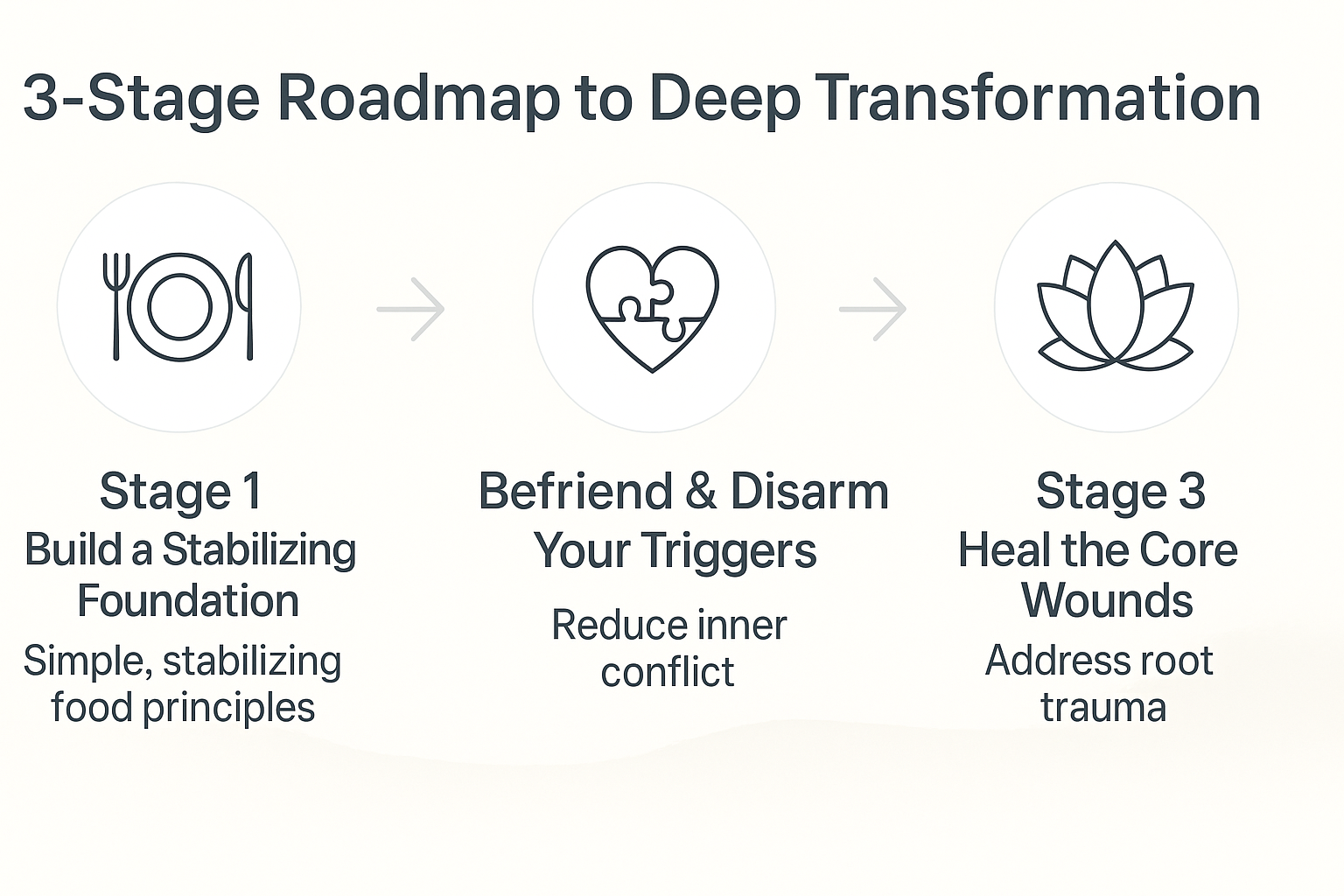
Our Enlighten Eats Course is designed to walk you through each stage of recovery: from confusion and shame to clarity, choice, and real nourishment.
If you’ve been stuck in the same loop for years, know this:
You’re not starting over. You’re starting from here. And here is enough.
6. Men, Parents, and Professionals Struggle Too — It Just Looks Different
BED doesn’t discriminate.
From athletes and therapists to parents and accountants, binge eating can show up in hidden, subtle ways. Especially for men or professionals, the disorder often goes unnoticed because of cultural expectations around control, competence, and masculinity.
Examples Include:
- Secret late-night eating after putting the kids to bed
- “Bulking” routines masking emotional eating
- Overworking paired with binge cycles on weekends
We must challenge the myth that eating disorders only affect young, thin women.
7. Shame Is the Glue That Keeps BED in Place
One of the most heartbreaking truths is this:
Binge eating is often fueled by shame — and kept alive by silence.
You binge → you feel ashamed → you promise to “do better” → the shame builds → the cycle repeats.
Breaking the cycle means making space for compassion before control.
This is where coaching can help. Having someone witness your truth — without judgment or fixes — can be the medicine you never knew you needed.
🤝 If that sounds like something your heart is craving, learn more about our coaching support.
8. Your Cravings Are Clues, Not Curses
When your body craves sugar, fat, or crunch — it’s not because it’s broken.
It’s because it’s communicating.
Cravings often signal:
- Blood sugar imbalance
- Emotional suppression
- Sleep deprivation
- Chronic stress or overstimulation
Start listening to your cravings as data, not danger. Ask:
What might I be truly needing right now?
9. Fullness Can Feel Unsafe — And That’s Normal
Many people with BED report feeling anxious or overwhelmed when they start to feel full — even if they just ate a reasonable meal.
Why?
Because fullness can be associated with past trauma, loss of control, or even ridicule.
Part of healing involves retraining the nervous system to tolerate enoughness — in food, rest, and even joy.
🌿 Tip: After a meal, place a hand on your heart and belly. Breathe. Notice any sensations. You are safe. You are here.
10. You Don’t Have to Do This Alone

Isolation is one of the most painful parts of binge eating — but it’s also one of the most unnecessary.
There is a community of people who understand. Coaches who hold space. Tools designed to support your real life, not someone else’s ideal.
You don’t have to do this alone. You never did.
Conclusion: There’s Nothing Wrong With You
Binge eating disorder is not a moral failure.
It is not a lack of willpower.
It is a brilliant, protective pattern that formed to help you survive.
And now, maybe… it’s time to move toward thriving.
Healing is not about getting it perfect. It’s about getting it honest.
Take your next step — gently. With support. With clarity. With love.
✨ Take the free quiz
🌱 Try the Mindful Meal Journal
💬 Explore coaching
🌈 Enroll in Enlighten Eats