

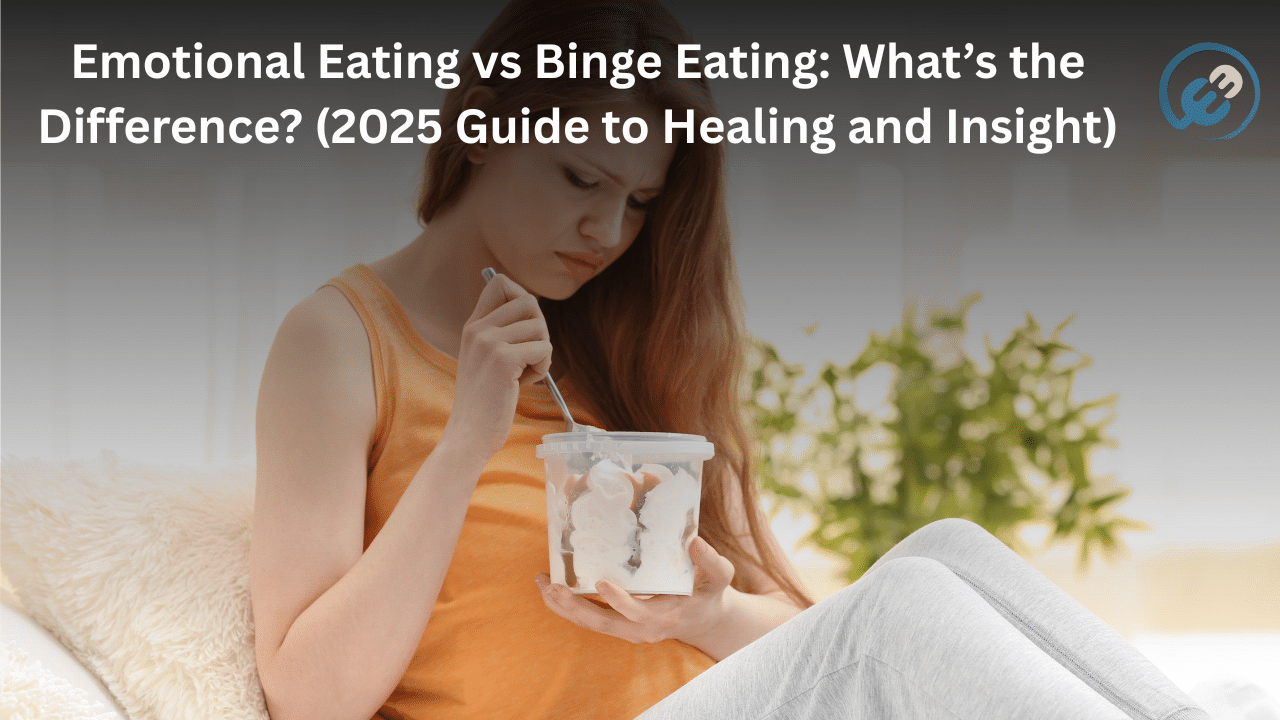
You’re not weak. You’re not broken. You’re not alone.
If you’ve ever found yourself standing in front of the fridge, not because you were hungry but because you were heart-heavy — this article is for you.
Maybe food has become your most dependable friend, your escape, or the only way to feel something. Maybe it spirals sometimes — a few bites turning into a frantic blur, followed by guilt that clings to your skin like shame.
What is happening here? Is it emotional eating? Is it binge eating? And does it even matter?
Yes. And gently — let’s explore why.
You don’t need another article shaming you. You need understanding. You need next steps that actually meet you where you are.
Curious about your relationship with food?
👉 Take our free quiz here — a gentle first step into clarity and care.
What Is Emotional Eating? The Tender Truth

Emotional eating is when we use food to soothe, distract from, or cope with emotional states — like sadness, boredom, stress, or even joy.
And here’s something radical: it’s not inherently bad.
It makes sense that we’d reach for a cookie during heartbreak, or chocolate after a hard day. Food is tied to comfort. It’s woven into memories, family, safety, and survival.
Signs You May Be Emotionally Eating:
- Eating when you’re not physically hungry
- Craving specific “comfort” foods during stress
- Using food to avoid feelings (like loneliness or grief)
- Feeling emotionally better — at least temporarily — after eating
Here’s the heart of it: emotional eating is coping. Sometimes skillful, sometimes not. But it’s rarely about food. It’s about what’s underneath.
Maybe your childhood lacked emotional attunement. Maybe you learned early on that crying wasn’t safe — but cookies were always available. Maybe your nervous system is constantly in overdrive, and food gives you the momentary exhale your body is starving for.
This isn’t failure. This is adaptation.
What Is Binge Eating? When Coping Becomes Overwhelming

Binge eating is a more intense, more painful pattern — one that often includes a sense of loss of control.
Clinically, binge eating involves:
- Eating a large amount of food in a short time
- Feeling out of control during the episode
- Eating until uncomfortably full, even in absence of hunger
- Experiencing shame, distress, or disgust afterward
The difference from emotional eating isn’t about how “bad” it is. It’s about intensity, frequency, and emotional aftermath.
Binge eating can feel like being hijacked by something bigger than you — a survival mechanism that kicks in when your nervous system has collapsed into shutdown or freeze.
“I don’t even remember chewing,” one woman shared. “It’s like I left my body, and when I came back, the damage was done.”
In many cases, binge eating disorder (BED) is not about food at all. It’s about disconnection — from self, from sensation, from feeling worthy.
And this is where trauma, nervous system dysregulation, and shame spirals often enter the picture.
Need help understanding binge eating disorder?
📘 Read our guide: Binge Eating Disorder DSM-5: How It’s Diagnosed and Treated
Key Differences Between Emotional Eating and Binge Eating
Let’s simplify this into something tangible:
| Aspect | Emotional Eating | Binge Eating |
|---|---|---|
| Trigger | Emotions: stress, sadness, boredom | Emotions + nervous system overwhelm |
| Control | Some level of awareness or choice | Loss of control, dissociation possible |
| Quantity | Usually moderate | Often large, fast, secretive |
| Aftermath | Temporary guilt or regret | Deep shame, physical discomfort |
| Frequency | Occasional | Frequent or part of a pattern/disorder |
But most importantly — both deserve compassion, not condemnation.
Why These Patterns Exist: A Deeper Look at Root Causes
Neither emotional nor binge eating are random. They are intelligent responses to unmet needs and unresolved pain.
Common Root Causes:
- Unprocessed trauma or neglect
- Perfectionism and harsh inner critics
- Restrictive dieting or food rules
- Cultural conditioning: thin = worthy
- Lack of safe emotional expression in childhood
- Hypervigilant or shut down nervous systems
This is more than psychological. It’s somatic. It’s relational. And sometimes — it’s systemic.
We live in a culture that tells us to control, perform, and shrink. Is it any wonder we learn to disconnect from our hunger — or drown it?
✨ If you want to explore the root causes and stages of healing in a holistic, structured way —
Explore our Enlighten Eats Course: a deep dive into food, feelings, and freedom.
How to Heal: Gentle Steps Toward Wholeness
Healing doesn’t begin with control. It begins with curiosity.
Here’s where many people start:
Step 1: Identify Your Pattern
Try journaling what you’re feeling before, during, and after eating. Are you soothing, escaping, numbing, or genuinely hungry?
📓 Our Mindful Meal Journal & App can help.
Track your meals and emotions — with no calorie counting, ever.
Step 2: Offer Yourself Safety
Many eating episodes happen because the nervous system is overloaded. Try:
- Deep breaths into the belly
- Gentle movement like stretching
- Splashing your face with cold water
- Talking to a safe person
Step 3: Rebuild Trust with Your Body
This means honoring hunger and fullness cues — even when you don’t “deserve” to eat.
Your body is not the enemy. It’s a wise, wounded friend.
Step 4: Get Support
You don’t have to untangle this alone.
🧠 Our coaching offers one-on-one guidance with compassionate practitioners who understand the emotional, somatic, and structural dimensions of disordered eating.
The Most Important Insight: You Are Not Broken

Whether you’re emotionally eating, bingeing, or somewhere in between — you are not failing. You’re surviving.
And there is a pathway forward that doesn’t rely on willpower or shame.
“I thought I had a food problem,” one client said. “But really, I had a self-trust problem.”
Healing is not linear. It moves in spirals. It asks for presence, not perfection.
So let this be your beginning — not a solution, but a soft turning toward yourself.
Conclusion: The Road Back to Yourself
There is no clear line between emotional and binge eating. What matters is that you notice, gently, what your body and soul are asking for.
You deserve care that honors your story, not punishes your symptoms.
💡 Ready to take the first step?
👉 Take our free quiz and begin your journey with kindness and clarity.
Or explore the Mindful Meal Journal if writing helps you feel connected.
You are not alone. You are not broken. You are already healing.