

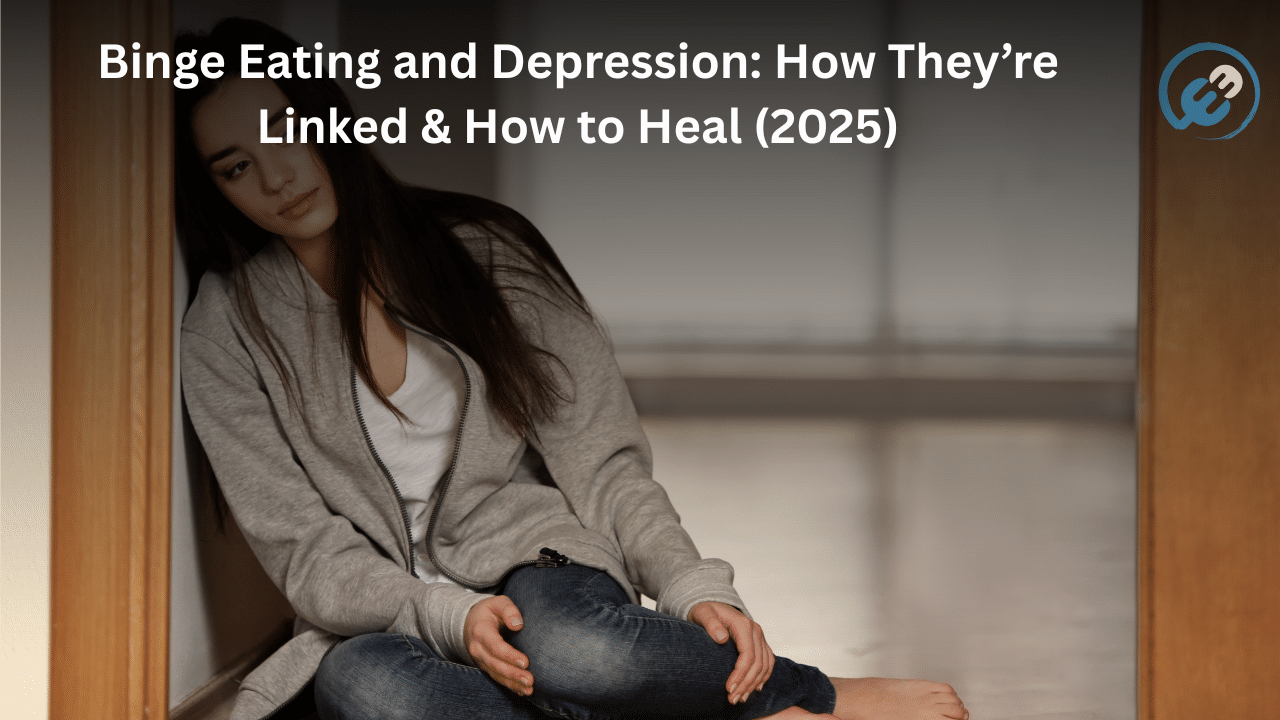
Some nights feel heavier than others.
You’re tired, but not just physically. Emotionally. Spiritually. You drift toward the kitchen—not out of hunger—but out of emptiness. A familiar ache begins to fill the silence. The pantry becomes a portal, not to nourishment, but to something. Escape. Comfort. Feeling.
And then, just as quickly: regret, shame, self-hate.
If this feels familiar, you’re not broken.
This article is for you.
It’s for anyone who’s ever tried to eat their way out of sadness, only to find themselves deeper in it. It’s for those quietly living with both binge eating and depression—two heavy experiences that often live in the same shadowed room.
We’ll explore:
- Why these two conditions are often linked
- What’s happening in your body and brain
- How cultural, nervous system, and emotional dynamics play a role
- And most importantly, what healing can look like
Curious about your relationship with food?
Take our free quiz to gently reflect on your patterns.
Why Depression and Binge Eating Often Go Hand-in-Hand

Depression can feel like living underwater. Everything is muted. Dull. Heavy.
In this space, binge eating often emerges as a way to:
- Feel something when you’re numb
- Distract from overwhelming sadness or self-criticism
- Create a sense of control or routine in the chaos
- Quiet a body that feels like too much to be in
Science affirms this link. A 2022 study in Frontiers in Psychology found that depressive symptoms significantly predicted the onset and maintenance of binge eating behaviors in both adolescents and adults (Santos et al., 2022).
But this isn’t just a behavioral overlap.
It’s a whole-person pattern—one shaped by:
- Unprocessed grief or emotional neglect
- Cultural pressure to be productive, cheerful, thin
- A nervous system stuck in freeze or collapse
- Self-beliefs that whisper: “I don’t deserve care”
You are not weak for eating this way. You are human.
Looking to begin healing from the root?
Explore the Enlighten Eats course, which unpacks how body, mind, and soul connect in disordered eating.
The Emotional Loop: Eating to Cope, Then Crashing Deeper
Here’s what the loop can look like:
- Emotional distress (numbness, sadness, fatigue)
- Binge eating to soothe, distract, or feel
- Temporary relief, followed by shame
- Self-punishment or restriction
- Rebound binge, deepened depression
This loop isn’t a lack of willpower. It’s a cycle born from pain.
It’s often rooted in developmental experiences—childhood environments where emotional expression was unsafe or unsupported. In those moments, food became a reliable form of comfort. Over time, the pattern calcified into habit.
We don’t break these loops with harsh rules.
We unwind them by asking:
- What was I feeling before the binge?
- What am I needing underneath the urge?
- Can I soften the shame with curiosity?
This is slow, sacred work. But it changes everything.
When Depression Lives in the Body: Fatigue, Freeze, and Food

Depression isn’t just mental—it’s somatic.
You might feel:
- Exhausted, even after sleep
- Numb, heavy, or disembodied
- Disconnected from hunger/fullness signals
- Lost in thought-loops you can’t exit
In these states, binge eating often arises from a nervous system stuck in shutdown. You might not feel “hungry” in the traditional sense—but eating becomes a way to move energy. To wake up. To self-soothe.
These are adaptive responses. They speak to the brilliance of your body trying to keep you afloat.
What helps?
- Gentle movement: stretching, rocking, even swaying
- Warm sensory input: tea, hot water bottles, cozy blankets
- Co-regulation: texting a safe person, listening to soothing voices
Want to begin building new daily rhythms?
Our Mindful Meal Journal App offers compassionate, structure-free support.
A Story: “I Thought I Was Just Lazy”
Daniel, 29, always thought his eating struggles were about discipline. He’d cycle between extreme restriction and late-night binges, each one followed by crushing guilt.
“I didn’t know I was depressed,” he says. “I just thought I was lazy.”
It wasn’t until therapy that he began to see the layers: the emotional neglect from his childhood, the body shame from early bullying, the belief that rest was weakness.
Binge eating was never about food. It was a symptom.
As he began journaling, slowing down, and practicing self-compassion, the binges softened.
“I still have hard days,” Daniel shares. “But I don’t hate myself for how I cope. And that alone feels like freedom.”
Healing isn’t perfection. It’s a shift in how we relate to our suffering.
Gentle Ways to Begin Healing from Both

Here are a few real, doable first steps:
🌱 1. Practice Compassion Over Control
- Say: “This is not my fault. My body is coping.”
- Remind yourself that shame never leads to lasting change.
🌱 2. Track Mood & Meals Without Judgment
- Use a non-diet journal to gently reflect on patterns.
- Notice: When do binges happen? What was I feeling?
🌱 3. Seek Nervous System Support
- Try breathwork, somatic therapy, or even petting a dog.
- Connect with people who feel safe, even if just virtually.
🌱 4. Unpack Root Beliefs
- “I’m broken.”
- “I don’t deserve care.”
- “No one will help me.”
These beliefs often live under the surface. Bringing them into the light is an act of liberation.
Ready for support that goes deeper than diets?
Our Coaching is designed for soul-level, body-informed recovery.
Conclusion: You Are Not Alone, and You Are Not the Problem
If you’re facing both depression and binge eating, please hear this:
You are not alone.
You are not lazy, weak, or hopeless.
You are someone responding—brilliantly, fiercely—to internal and external pain. Your eating is not the issue. It’s a signal. A symptom. A story.
And stories can be rewritten.
Healing isn’t about “fixing” yourself. It’s about learning to walk with your pain in new ways—with curiosity, compassion, and community.
You’re already on the path. This article was a step.
Want to understand your eating patterns better?
Take the free quiz. No pressure—just insight.