

Have you ever wondered how something as seemingly simple as food could feel so complicated? For millions of people, anorexia nervosa isn’t just about eating less or fearing weight gain. It’s a deep, intricate struggle rooted in emotions, culture, biology, and relationships.
Did you know that anorexia affects around 1% of women and 0.3% of men worldwide, and it has the highest mortality rate of any psychiatric illness? Behind these numbers are real lives, each carrying unimaginable pain, seeking relief in ways that too often remain unseen.
I’ve always believed recovery begins with understanding—not judgment, not quick fixes, but genuine compassion for the complexities of what someone is facing. That’s why it’s so important to look at anorexia with a lens that captures its many dimensions.
I want to introduce you to Integral Theory, a powerful framework that explores human experience through four perspectives, or “quadrants.” These quadrants include everything from our inner thoughts and emotions to the societal systems and cultural norms that shape our lives. By using this approach, we can better understand not just the “what” of anorexia but the “why” and “how” of healing.
Curious about your own relationship with food? Take our free Eating Enlightenment Quiz to uncover insights into your eating habits and patterns. It’s a gentle starting point for deeper reflection. To learn more about holistic healing, see here.
Together, we’ll explore how the mind, body, and world around us intersect in this complex experience of anorexia, paving the way for healing that feels whole and meaningful.
What Is Anorexia Nervosa?
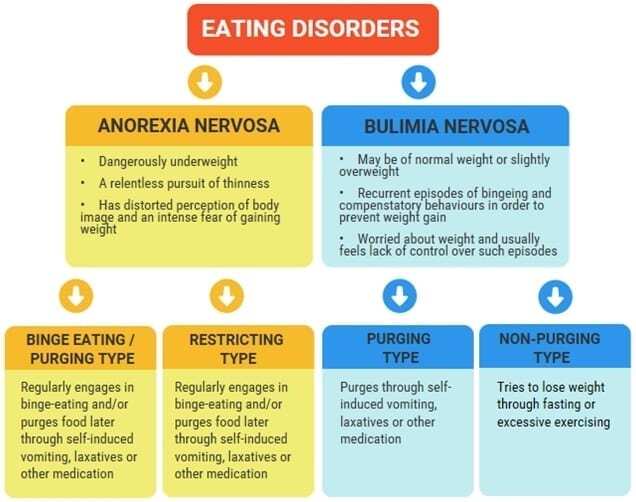
Have you ever looked in the mirror and felt like what you saw didn’t match reality? Anorexia nervosa is like that feeling but amplified to an unbearable degree.
Defined by extreme food restriction, a deep fear of weight gain, and a distorted body image, this disorder isn’t just about food or appearance. It’s about pain, control, and often a desperate attempt to manage inner turmoil when life feels out of control.
To put the gravity of anorexia into perspective, here’s a statistic that might surprise you: It has the highest mortality rate among psychiatric disorders, with about 5% of those affected succumbing to complications if left untreated (NIH, 2021). That’s not just a number. It’s countless lives, voices, and stories of struggle and silence.
I remember hearing about “Emma,” a fictional composite of so many real experiences.
She was a high school athlete who avoided pizza nights with friends, claiming she “wasn’t hungry.” She never skipped practice but often felt dizzy. When her parents became concerned about her weight, she brushed it off, saying she was just “healthy” and “focused.”
These early signs went unnoticed until she ended up in the hospital for fainting during a workout. Stories like Emma’s remind us how subtle the red flags can be and why awareness matters so much.
Understanding Anorexia Nervosa Through the Four Quadrants
Anorexia nervosa is like trying to untangle a ball of yarn that’s knotted at every angle. It’s not just about eating less or fearing weight gain; it runs much deeper.
Integral Theory helps us see anorexia more fully by framing it through four interconnected perspectives, or quadrants. These show us how inner experiences, biology, culture, and external systems all play a role.
If this sounds like a lot, don’t worry—I’ll break it down with a story and some practical tools.
The Four Quadrants of Anorexia
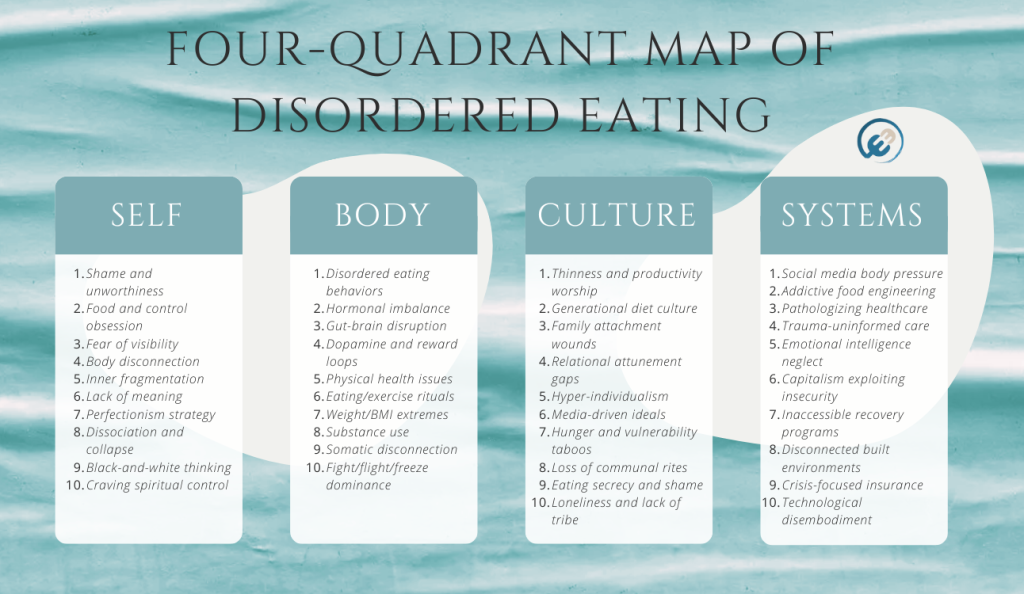
Think of the four quadrants as a 360-degree view of anorexia. Here’s how it works:
- Individual-Interior (Inner Experience): The personal and emotional world. This is where distorted body image and perfectionism live.
- Individual-Exterior (Biological Factors): The physical realities, like genetics, malnutrition, and hormonal changes.
- Collective-Interior (Cultural Influence): The societal norms and pressures about beauty and body image, often shaped by social media.
- Collective-Exterior (Relationships & Systems): The external environments, such as family dynamics, media consumption, and healthcare accessibility.
By putting these together, we can start to see why anorexia develops and, importantly, how healing begins.
Causes of Anorexia Through the Quadrants
I want to share a story that shows all these pieces in action. My friend “Sophia” struggled with anorexia throughout high school. On the surface, it looked like she had it all. She excelled in school, joined every club, and held straight “A’s.”
But over time, we noticed she became more distant. She started skipping meals at family barbecues or claiming she had already eaten during group lunches. Her weight dropped, and she grew physically weaker. At first, people pointed fingers at her “self-control,” but here’s what was really happening:
1. Subjective Experience (Inner Quadrant)
Beneath the surface, Sophia used food as a way to control emotions she couldn’t express. Between school pressure and turmoil at home, restricting calories became her shield.
2. Biological Reality (Physical Quadrant)
Because Sophia ate so little, her body eventually went into survival mode. Her periods stopped, her hair thinned, and she constantly felt cold—even in July. This isn’t a “choice”; it’s biology reacting to prolonged starvation.
Fast Fact: Did you know anorexia has a genetic heritability rate of 50-80%? (APA, 2023). Genetic differences in serotonin and dopamine can influence hunger regulation and anxiety control.
3. Cultural Influence (Shared Norms & Media)
Sophia spent hours scrolling through filtered images of “thinspiration” influencers. These impossible beauty ideals, amplified by likes and follows, reinforced her belief that thinness equaled worthiness.
Quick Tip:
Parents can model healthy habits by reframing conversations about beauty. Instead of commenting on physical appearance, praise qualities like kindness, effort, or creativity.
4. Relational & Systemic (Family & Society)
Finally, Sophia’s family unknowingly shaped how she saw food. Her mom was always dieting, often making statements like, “I feel so guilty eating that bread.” And while they loved her dearly, her parents often focused on achievements, praising her for her grades more than her feelings.
What you can do:
- If you’re a parent, practice positive modeling. Avoid labeling foods as “good” or “bad.”
- Build secure attachments by validating emotions. Simple affirmations like “I hear you” or “It’s okay to feel upset” go a long way toward rebuilding trust.
Quadrants at a Glance
Here’s a quick visual summary to tie it all together:
| Quadrant | Focus Area | How It Shows Up in Anorexia | Actionable Steps |
| Inner Experience | Thoughts, feelings, emotions | Anxiety, perfectionism, low self-worth | Journaling, CBT-based thought exercises |
| Physical Reality | Biology and behaviors | Weight loss, hair thinning, hormonal shifts | Medical/nutritional support plans |
| Cultural Influence | Media and societal pressures | Thin idealization, body dissatisfaction | Social media audit, media literacy tools |
| Relational Environment | Family, social structures | Diet culture, attachment insecurity | Family therapy, emotional validation |
This framework helped Sophia’s family understand her anorexia wasn’t one-dimensional.
They stopped focusing only on food and started addressing the full picture. Therapy didn’t just rebuild her self-esteem; it gave them tools to improve family communication, too.
Treating Anorexia Nervosa Through the Lens of Integral Theory
Anorexia nervosa is a complex and multi-dimensional condition that affects the body, mind, and relationships in deeply interwoven ways. It demands an equally nuanced approach to treatment.
Ken Wilber’s Integral Theory, often described as “a theory of everything,” presents a revolutionary framework for addressing such challenges by integrating diverse perspectives.
This theory offers a way to analyze and treat anorexia that accounts for its multifaceted nature, emphasizing a truly holistic approach to healing.
Integral Framework for Anorexia Treatment
| Quadrant | Examples in Anorexia | Focus of Intervention |
| Individual Interior | Body dysmorphia, perfectionism, low self-worth | Cognitive therapy, mindfulness, emotion regulation |
| Individual Exterior | Starvation, physical health decline, weight loss | Nutritional rehabilitation, medical monitoring |
| Collective Interior | Idealization of thinness, stigmas around food and body image | Cultural sensitivity, psychoeducation, media literacy |
| Collective Exterior | Social media, family dynamics, healthcare access | Family therapy, community support systems, policy advocacy |
By addressing each of these quadrants, clinicians can create treatments that account for the entirety of a person’s lived experience with anorexia.
Stages of Recovery from Anorexia Through the Lens of Integral Theory
When it comes to recovering from anorexia, the road isn’t a straight line.
The 4 Quadrants come from Ken Wilber’s Integral Theory and are a way to understand the different dimensions of anorexia.
They don’t focus on time or progression but instead look at the areas of life that anorexia impacts. Think of them as a snapshot of all the factors influencing someone’s experience with the disorder at any given moment.
The quadrants are like a holistic lens to understand how anorexia exists in someone’s life. They help identify what’s contributing to the disorder and where interventions might be needed.
The Stages of Recovery, on the other hand, are about progression over time. They describe the journey someone takes as they heal from anorexia, moving from survival to self-actualization.
These stages are dynamic and show how recovery evolves step by step.
Key Differences (Causes of Anorexia VS Stages of Treatment of Anorexia)
- Focus:
- The 4 Quadrants focus on what influences anorexia (thoughts, body, culture, systems).
- The Stages focus on how recovery unfolds over time.
- Perspective:
- The 4 Quadrants are a snapshot of the present moment, looking at all the factors at play.
- The Stages are a journey, showing progression and growth.
- Application:
- The 4 Quadrants help identify areas to target in treatment (e.g., cultural pressures or physical health).
- The Stages guide someone through the recovery process, step by step.
Think of the quadrants as the map of all the factors influencing anorexia, while the stages are the path someone takes to move through recovery.
Together, they provide a comprehensive way to understand and treat the disorder, addressing both the “what” and the “how.”

1. Red Stage – Survival and Stabilization
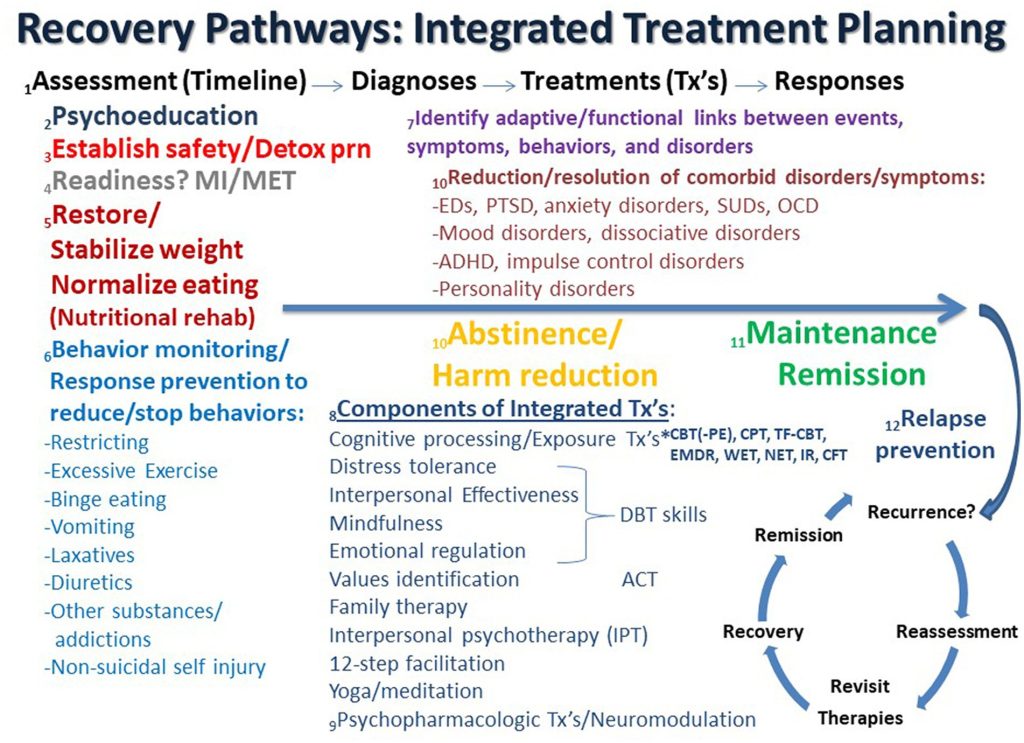
If you’re in the Red Stage, everything likely feels urgent. Your body is struggling, and survival is the first priority. This phase often comes into play when someone’s physical health is at critical levels, like when malnutrition leads to serious complications.
I had a friend, “Ellie,” who only started her recovery when she fainted during a family dinner. For months, she had ignored the signs her body was failing, convinced she’d regain control on her own. That moment shook her, and it became the start of her stabilization process.
Characteristics of the Red Stage
- Focus: Staying alive and stabilizing physically.
- Behaviors: Resistance, denial, and fear of losing control.
- Challenges: Mistrusting caregivers and struggling to see the severity of the disorder.
Practical Steps to Move Forward
- Reintroduce Nourishment: Work with a dietitian to rebuild your body, one meal at a time. Start small; sometimes even adding a snack can feel monumental.
- Medical Oversight: Address urgent concerns like electrolyte imbalances or heart health with professionals.
- Safe Spaces: Create an environment where food isn’t tied to shame or judgment. Finding a therapist who is compassionate and non-coercive can be a game-changer.
Recovery begins here, with the body and emotions stabilized, even if it feels like the smallest of steps.
2. Amber Stage – Structure and Support
Once the urgency has passed, structure becomes essential. This is the Amber Stage, where you might find comfort in routines, meal plans, and external guidance. It’s a phase where rules feel helpful, even if deep emotional work hasn’t yet begun.
Take “Sam,” for example, who told me they’d only eat meals when their mom sat with them, counting every bite. It gave them accountability, but their relationship with food was still fragile. Meals felt more like a rule to follow than something they could trust themselves with.
Characteristics of the Amber Stage
- Focus: External support and structure.
- Behaviors: Reliance on therapists, family, and treatment plans.
- Challenges: Struggling to develop internal motivation and feeling guilty for not being “perfect” at recovery.
Practical Steps to Move Forward
- Family-Based Treatment: Work as a team where loved ones help normalize eating and set clear expectations.
- Coping Skills: Learn tools like deep breathing or journaling to manage food-related anxiety.
- Education: Understand that anorexia is a real condition caused by many factors—not a personal flaw or lack of willpower.
This stage is about building a steady foundation that provides clarity and confidence for the next steps.
3. Orange Stage – Reason and Independence
At the Orange Stage, clarity begins to emerge. You start connecting the dots between your behaviors, thoughts, and emotions. It’s empowering to take ownership of your recovery and to explore what motivates you personally.
For me, this stage reminds me of my former student, “Jen.” She told me, “I realized I wanted to recover—not just to check the boxes for my therapist—but to actually live the life I’ve been missing out on.” She began setting small, manageable goals, like eating a “fear food” once a week, and celebrated every win.
Characteristics of the Orange Stage
- Focus: Rational understanding of the disorder and personal responsibility for change.
- Behaviors: Developing self-awareness and setting recovery goals.
- Challenges: Vulnerability during stress and setbacks.
Practical Steps to Move Forward
- Challenge Negative Beliefs: Write down one self-critical thought daily, then rewrite it as a kinder, more constructive version.
- Practice Mindful Eating: Notice the tastes and sensations of food to reconnect with your body. Start small, even with one bite.
- Set Goals: Create recovery milestones, like trying new foods or attending social meals, that build confidence step by step.
This stage pushes you toward a more reflective and active role in your healing while strengthening your resilience.
4. Green Stage – Empathy and Connection
The Green Stage is where you seek deeper emotional healing. Relationships and cultural influences come into focus as you gain the strength to process past wounds and advocate for broader change.
One of my favorite moments with a recovery group I volunteered in was when “Amy” shared how she’d stopped following diet accounts on Instagram and replaced them with body-positive influencers. “It’s amazing how differently I see myself,” she said. “I used to compare myself to everyone. Now, I’m just me.”
Characteristics of the Green Stage
- Focus: Emotional growth and deeper connections.
- Behaviors: Willingness to process trauma and challenge cultural ideals.
- Challenges: Finding balance between empathy for others and maintaining personal boundaries.
Practical Steps to Move Forward
- Relational Therapy: Explore family dynamics and rebuild trust where it was lost.
- Advocate for Change: Speak out against harmful beauty standards or support recovery nonprofits.
- Foster Emotional Safety: Surround yourself with peers and family members who affirm your growth and values.
This stage isn’t just about recovery from anorexia. It’s about rebuilding connections—with yourself and others.
5. Teal Stage – Integration and Purpose
The Teal Stage represents self-actualization. At this point, recovery becomes integrated into who you are. Food is no longer the enemy, but a source of nourishment and joy. You’ve built a life that feels meaningful and aligned with your values.
I once heard “Alex,” now a recovery advocate, say, “I don’t live to fight anorexia anymore. I live to help people like I once was.” For Alex, recovery wasn’t the end of their story but the start of something much bigger.
Characteristics of the Teal Stage
- Focus: Fully embodying recovery and finding life purpose.
- Behaviors: A balanced relationship with food and self, with greater focus on fulfillment.
- Challenges: Adapting to new transitions, like careers or family life.
Practical Steps to Move Forward
- Integrative Practices: Consider yoga, journaling, or art to nurture a sense of connection and peace.
- Future Planning: Work with a life coach to set career or personal goals.
- Give Back: Become a mentor to someone earlier in their recovery or advocate for better mental health awareness.
By this stage, anorexia is no longer the defining feature of your life. Instead, your growth and purpose take center stage.
Recovery Stages at a Glance
| Stage | Focus | Challenges | Therapeutic Tips |
| Red (Survival) | Stabilization | Resistance, mistrust | Nutritional rehab, crisis management |
| Amber (Structure) | Routine and support | Rigidity, external dependence | Family support, coping tools, FBT |
| Orange (Reason) | Rational clarity | Emotional setbacks | CBT, mindfulness, goal setting |
| Green (Empathy) | Emotional healing | Balancing trauma & relationships | Relational therapy, cultural critique |
| Teal (Integration) | Self-actualization | Facing life transitions | Holistic practices, life coaching, advocacy |
An Invitation to Healing
Understanding anorexia demands compassion for its myriad origins. Just as the quadrants of Integral Theory reveal the interconnected nature of human existence, healing requires a holistic and inclusive approach.
To those affected by anorexia, remember this is not a battle you have to fight alone. Access resources, reach out for support, and honor the courage it takes to move toward recovery. Transforming the relationship with food, body, and self is more than healing tissues or curbing fears; it’s about reclaiming life as a whole.