

If you’re reading this, maybe you’ve spent years swinging between control and chaos with food.
Maybe you’ve counted calories, cut carbs, skipped meals, and then — in the quiet moments — eaten in secret. Maybe you’ve felt the shame settle in afterward, wondering why something as basic as eating could feel so complicated.
If so, you’re not alone. And you’re not broken.
This is the experience of so many — and the good news is, people are finding freedom.
Intuitive eating isn’t a diet. It’s a return. A remembering. A way of eating that centers on listening to your body, honoring your hunger, and healing your relationship with food — from the inside out.
In this article, we’ll explore real-life intuitive eating success stories. You’ll meet people who once struggled, just like you, and who now eat with trust, compassion, and joy.
🌱 Curious where you stand with food?
Take our Free Food Patterns Quiz to get personalized insights into your current relationship with eating.
What Is Intuitive Eating — and Why Do So Many People Find Healing Through It?

Intuitive eating is a non-diet approach that teaches you to listen to your body’s natural hunger and fullness cues. But that definition barely scratches the surface.
For most people, the journey into intuitive eating is also a journey:
- Out of shame
- Through grief
- Into embodiment
As Elyse Resch and Evelyn Tribole, the co-creators of Intuitive Eating, describe, it’s a process of making peace with food — not forcing change, but nurturing trust.
One study found that intuitive eating was linked to lower disordered eating behaviors and higher body appreciation, particularly in women with histories of dieting and body shame (Tylka & Kroon Van Diest, 2013)【APA】.
But these stories aren’t about research. They’re about real people. Let’s meet them.
Story #1: “Food Stopped Being My Enemy”
Name: Lauren, 33
Backstory: Decades of dieting, shame, and binge cycles
“I was on my first diet at 11. By 30, I’d lost and gained the same 40 pounds five times. My life was ruled by what I ate — or didn’t.”
For Lauren, intuitive eating felt radical. She began by giving herself unconditional permission to eat — and was terrified.
But over time, something softened. The binges lessened. The guilt faded.
“Now, I can eat pizza without spiraling. I trust my hunger. I don’t wake up thinking about how to fix myself.”
Lauren’s Turning Points:
- Journaling her hunger/fullness daily
- Practicing body neutrality instead of positivity
- Learning to separate worth from weight
📝 Want to understand your eating patterns like Lauren did? Try our Mindful Meal Journal App — a gentle tool to bring awareness without shame.
Story #2: “I Realized I Wasn’t Actually Hungry — I Was Lonely”

Name: Mark, 41
Backstory: Emotional eating during work stress, late-night snacking, guilt cycles
“I’d eat three dinners a night, not because I was hungry, but because I was overwhelmed and alone.”
Mark didn’t think intuitive eating was “for guys.” But after a panic attack at work, he started therapy — and eventually found intuitive eating through a podcast.
“What clicked was that I didn’t need a diet — I needed to feel safe. I started asking, ‘What am I really hungry for?’”
Mark’s Tools for Healing:
- Naming emotions before meals
- Reaching out instead of numbing
- Eating slowly, without screens
🍽 Healing often begins in the body. Mark’s success came through nervous system regulation, not calorie counting.
If you resonate with this, the Enlighten Eats Course gently explores the emotional and somatic roots of food struggles.
Story #3: “I Had to Grieve the Fantasy of Thinness”
Name: Priya, 29
Backstory: Compulsive exercise, perfectionism, food rules
“I was chasing a body that didn’t exist. And food was either a weapon or a reward.”
For Priya, the hardest part of intuitive eating wasn’t the food — it was the grief. Grieving the dream of control. Grieving the cultural lies that said her body wasn’t enough.
But with support, she learned to:
- Move for joy, not punishment
- Eat without labeling food as “good” or “bad”
- Rest without earning it
“Now, my body feels like a friend — not a project.”
Worldview Insight: Many eating struggles begin in early messages about safety, worth, and control. Intuitive eating becomes a spiritual return to self — a reparenting.
💬 Want to explore these layers in a supportive space? Our 1-on-1 Coaching offers compassionate guidance tailored to your journey.
What All These Stories Share

Though each journey is unique, intuitive eating success stories share several themes:
✨ A shift from control to trust
Most people begin intuitive eating expecting to “manage” food better — but stay because they learn to trust their bodies again.
✨ The uncovering of deeper needs
Food is never just about food. These stories reflect emotional hunger, somatic dysregulation, and the need for connection.
✨ The presence of community or support
No one heals in isolation. Recovery is relational. Whether through coaching, journaling, or peer support, connection matters.
Gentle Practices for Beginning Intuitive Eating

If you’re ready to start — or re-start — here are a few gentle ways to begin:
- Try the Hunger-Fullness Scale: Check in before and after eating
- Drop the Judgment: Notice when “good/bad” thinking arises
- Name Emotions Before Meals: Is it hunger or something else?
- Let Go of Numbers: Pause calorie tracking for one week
- Explore Embodiment: Stretch, breathe, or touch your body with care
💡 Want a place to reflect as you eat? Our Mindful Meal Journal & App is built for intuitive eaters.
The Challenges No One Talks About (But You Need to Hear)
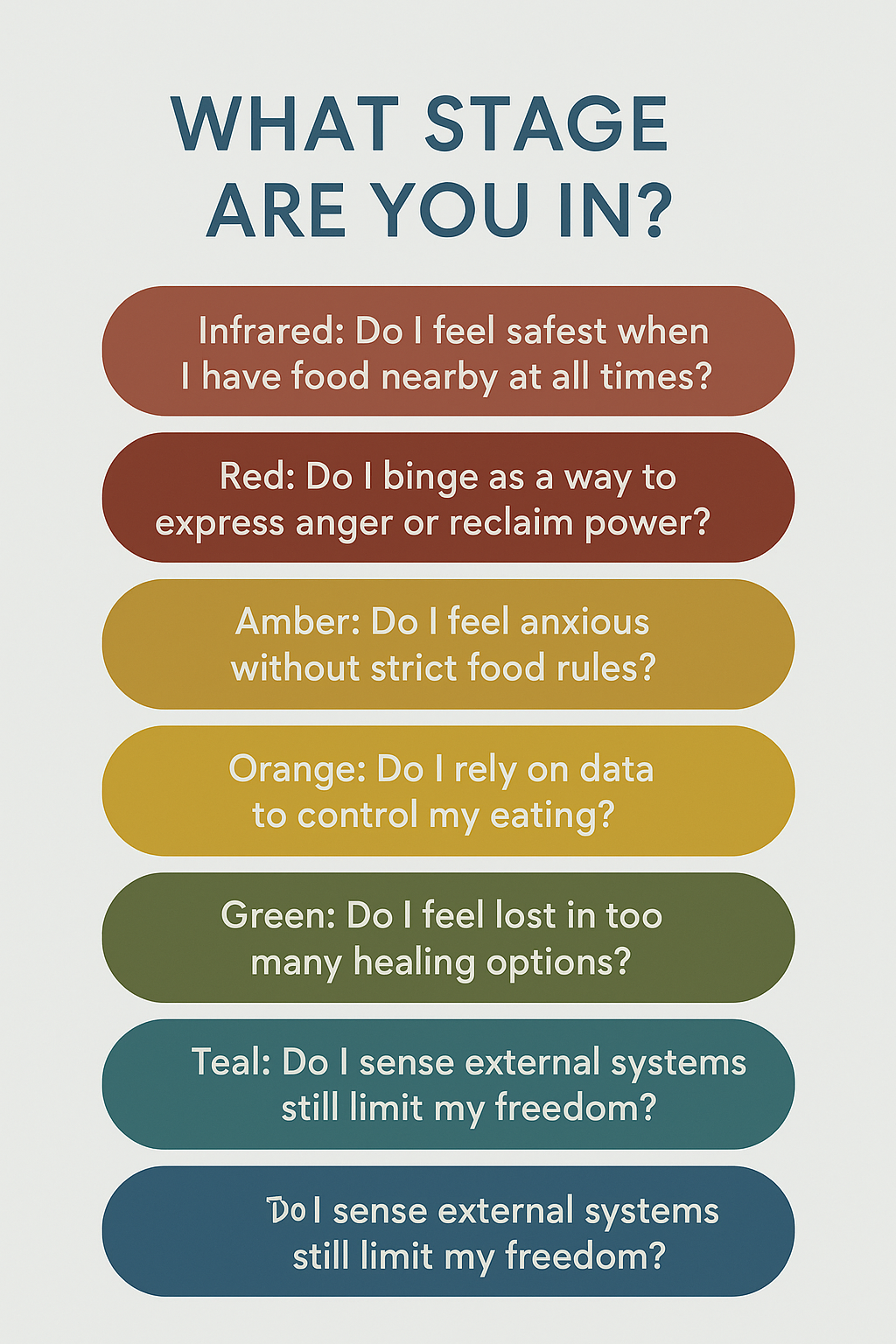
Intuitive eating is simple, but not easy. Many people struggle with:
- Fear of weight gain
- Feeling out of control at first
- Grieving the identity of the “disciplined” one
- Doubt: “Can I really trust my body?”
These struggles are not failures — they are invitations. They often reflect nervous system dysregulation (e.g., freeze or fawn responses), perfectionism, or a lifetime of cultural conditioning.
Give yourself grace.
Conclusion: This Journey Is Worth It
If you’ve spent years fighting your body, punishing your hunger, or micromanaging every bite — intuitive eating can feel like a foreign language at first.
But it’s actually your native tongue.
It’s how your body wants to speak to you. Through hunger. Through fullness. Through pleasure. Through rest.
You are not broken — you are returning.
And as these stories show, that return is beautiful, possible, and deeply healing.
🌱 Ready to take the first step?
Start with our Free Quiz and begin mapping your path back to food freedom.