

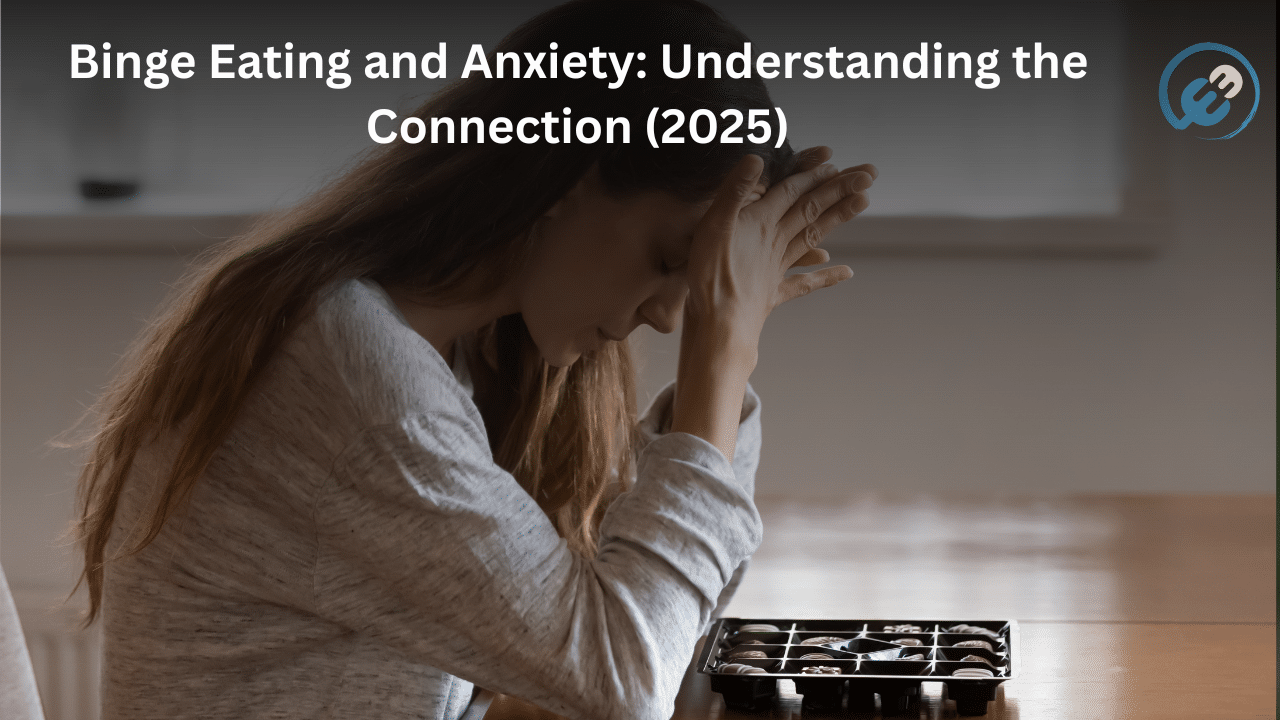
There’s a moment—maybe you’ve felt it—when your chest tightens, your thoughts race, and the only thing that seems to help is food.
You don’t want to binge. But somehow, it happens again. And afterward, the shame creeps in: Why can’t I stop? What’s wrong with me?
If you’ve ever found yourself eating not from hunger, but from panic, numbness, or an aching tension you can’t name… you’re not alone. And you’re not broken.
In this article, we’ll explore the very real, very human connection between binge eating and anxiety. Not in a clinical, distant way—but in the way it feels in your body. In the way it shapes your day. In the way it makes you feel like you’re quietly unraveling while the world carries on.
We’ll also gently explore how healing happens—not through force or willpower, but through understanding, co-regulation, and compassionate steps forward.
Curious about your relationship with food?
Take our free quiz for gentle insight into your eating patterns.
How Anxiety Fuels Binge Eating (And Why It’s Not About Willpower)

Anxiety isn’t just in your head. It’s in your nervous system. It’s in your gut. It’s in the way you brace yourself every time your phone buzzes or someone looks at you too long.
When that internal pressure builds up—tight chest, shallow breath, the frantic need to do something—it’s not unusual to reach for food.
Food becomes a survival tool.
It slows you down. Grounds you. Distracts you. And for a moment, it works.
Here’s why:
- Biologically, eating carbs and sugar can momentarily lower cortisol (the stress hormone).
- Neurologically, binge eating may activate the parasympathetic nervous system, offering temporary calm.
- Emotionally, food becomes a buffer from spiraling thoughts and bodily discomfort.
A 2019 study in Appetite found that anxiety symptoms were strongly predictive of binge eating severity, with emotional regulation difficulties serving as a key mediator (Larsen et al., 2019).
This isn’t a matter of “bad habits.”
It’s a coping mechanism shaped by your body’s honest attempts to feel safe.
The Vicious Cycle: How Shame and Control Keep You Stuck

After a binge, the inner critic wakes up.
“You’re disgusting.”
“You’ll never get better.”
“You have no self-control.”
These thoughts don’t motivate change. They entrench the cycle.
Here’s how the loop often goes:
- Anxiety rises from stress, fear, or unresolved trauma.
- Food offers temporary relief.
- Shame sets in, and the desire to “fix” or restrict emerges.
- Restriction backfires, heightening anxiety and increasing the likelihood of another binge.
This cycle is often reinforced by diet culture, which teaches that control = virtue and hunger = weakness. But true healing rarely comes from more control. It comes from presence, permission, and co-regulation.
Want to gently track your emotions and hunger cues?
Our free journal app is designed to support mindful awareness without judgment.
The Role of the Nervous System: Why You Freeze, Numb, or Disconnect
Sometimes anxiety doesn’t feel panicky—it feels like nothing.
You’re numb, spaced out, or exhausted. You don’t even realize you’re bingeing until the food’s gone.
That’s not failure. It’s a sign of nervous system dysregulation—your body trying to protect you from overwhelm by shutting down.
Common signs include:
- A foggy or disconnected feeling
- Eating rapidly without tasting
- Sudden spikes in hunger after periods of emotional flatness
- Trouble identifying hunger or fullness cues
These are not personality flaws. They are body responses.
And the antidote isn’t control. It’s co-regulation—being seen, felt, and supported by safe connection. Sometimes that starts with a therapist. Sometimes it starts with one compassionate article. Sometimes it starts with breath.
If you’re ready to deepen your healing with guidance and community,
Explore our Enlighten Eats course, which gently unpacks root causes and compassionate recovery steps.
Real-Life Reflection: “I Didn’t Know I Was Anxious Until I Stopped Bingeing”
Samantha, 32, didn’t think she was an anxious person. “I was just always busy. I thought I was being productive. But when I started working with a coach and slowed down, I realized I’d been living in a state of constant pressure. Food was the only place I relaxed.”
Her turning point came not from a rigid meal plan, but from learning to notice her body.
“I started asking: What am I actually feeling? Sometimes it was sadness. Sometimes it was terror. But the more I made space for those feelings, the less I needed food to hold them for me.”
Her story mirrors so many we hear. Binge eating doesn’t just vanish—but the grip of it softens. And anxiety doesn’t disappear overnight—but it becomes something you can be with, not just run from.
Gentle Tools for Managing Anxiety Without Bingeing
There’s no one-size-fits-all. But these practices can help you reconnect to safety without needing to numb:
🌿 Before the Binge:
- Place one hand on your heart, one on your belly. Ask: What do I need right now?
- Sip something warm (tea, broth) and breathe deeply while holding the cup.
- Try a 5-minute grounding video or playlist designed to calm your nervous system.
🌿 After the Binge:
- Resist the urge to restrict. Nourish your body gently at the next meal.
- Journal one thing you were feeling before you started eating.
- Say aloud: “This is not my fault. My body is trying to keep me safe.”
🌿 Ongoing Support:
- Build a routine of mindful meals with our app.
- Schedule compassionate check-ins (even with yourself).
- Seek co-regulation: friends, support groups, or trauma-informed coaching.
If you’re looking for a more personalized approach,
Learn about our one-on-one coaching here.
What Healing Actually Looks Like: Beyond the Binary of “Fixed” or “Broken”
Healing isn’t linear. You’re not a “before and after” story. You’re a human being—learning, growing, forgetting, remembering.
Some days you’ll feel grounded. Some days you’ll binge. Both are part of the path.
What matters is:
- Replacing shame with curiosity
- Building new internal and relational safety
- Remembering that food is not the enemy—it’s a messenger
There’s no finish line, but there are milestones:
- The first time you pause mid-binge and check in
- The first time you name an emotion instead of eating it
- The first time you realize you don’t need to binge to survive a wave of anxiety
And through it all, your worth is constant. You are not the problem. You are someone finding your way back to wholeness.
Conclusion: A Gentle Reminder That You’re Not Alone
If binge eating and anxiety are part of your story, know this: you are not alone, and you are not broken.
These behaviors make sense. They emerged for a reason. And while they may not serve you anymore, your body is not betraying you. It’s doing its best to keep you safe.
You don’t have to fix everything today. You only have to take the next compassionate step.
Feeling curious about what’s driving your eating habits?
Take our free quiz for a gentle starting point on your path to clarity.