
You are overeating large amounts of food and are out of control.
After eating, you are uncomfortably full.
You suspect binge eating disorder – but you aren’t quite sure.
How do you know if you have binge eating disorder?
What are the signs? Symptoms?
First, take the Emotional Eating Quiz at the top of this article.
This quiz asks about the 13 main criteria used to diagnose binge eating disorder from a medical perspective.
After submitting your email, you’ll be able to access your results.
What Is Binge Eating Disorder?

In 1959, Albert Stunkard, a psychiatrist and researcher, first came up with the term Night Eating Syndrome.
This is now known as binge eating disorder, and it’s not restricted to nighttime.
Since then, there has been much research into binge eating disorder.
The National Eating Disorders Association has conducted nationwide surveys, and several binge eating statistics have become clear:
- Approximately 3.5% of women and 2% of men in the United States receive a medical diagnosis of Binge Eating Disorder.
- This means that 2.8% of people in the United States will receive a medical diagnosis of Binge Eating Disorder in their lifetime.
A’s is only counting the number of people who are officially diagnosed!
For every person diagnosed with Binge Eating Disorder, there are probably 5-10 more who have the disorder or lesser forms of the eating disorder but who never receive a diagnosis.
For example, many people who seek weight loss will fall off the way” and binge eat! However, they typically are not aware that this is a form of binge eating disorder and wouldn’t consider this a binge.
They can justify and rationalize their binge eating by saying just this one t”e” or never aga.”
Yet, losing control is still losing control. And do people seeking weight loss do you think to lose power during their dieting?
The weight loss industry in America is worth many billions. Americans are obsessed with weight loss.
How many people attempting extreme dieting and weight loss end up binge eating but aren’t accounted for?
Dealing with binge eating disorder can be challenging. Food journaling improves self-awareness, supports weight management, and encourages mindful eating.
The Eating Enlightenment Food Journal App is user-friendly, customizable, and motivational. Download it on iOS and Android to start your journey towards balanced eating and holistic well-being today.
Characteristics Of Binge Eating
Binge Eating Disorder has also been known as:
- Compulsive overeating
- Emotional eating
- Food addiction
While these eating terms overlap in meaning, Binge-Eating Disorder has its clinical definition.
This is based on the tremendous amount of scientific research on binge eating disorders, with careful consideration being given to the clinical definition of binge eating.
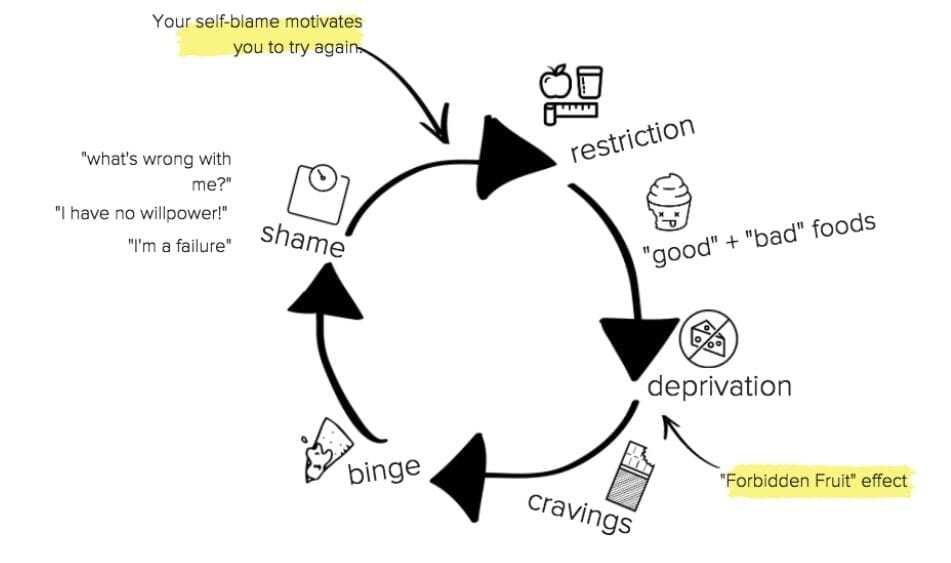
We’ll cover the clinical definition shortly, but to keep things simple, here are the four main symptoms of Binge Eating Disorder:
- Loss Of Control
- Overeating or Bloated
- Guilty / Ashamed
- Repeat
How Do I Know If I Have Binge Eating Disorder?
If you have the four points above, you may have a Binge Eating Disorder.
All conditions must be present.
However, as mentioned earlier, Binge Eating Disorder has its clinical definition.
Binge Eating Disorder is not loosely defined as food addict”, which has a precise definition.
The National Eating Disorders Association lists the criteria for Binge Eating Disorder:
- Have a Binge Eating episode at least once per week for the past three months.
(an episode is defined as a vast amount of food, according to the person in question, eaten within two hours)
- Three or more of the following symptoms must also be present:
- eating large amounts of food much more rapidly than normal
- consuming large quantities of food until uncomfortably full
- eating large amounts of food without feeling hungry
- eating alone due to feelings of embarrassment and shame
- feelings of guilt or disgust with oneself
Furthermore, the clinical definition includes an ” i” de” regarding the severity of the Binge Eating behaviors:
- Mild: 1-3 binge-eating episodes per week
- Moderate: 4-7 binge-eating episodes per week
- Severe: 8-13 binge-eating episodes per week
- Extreme: 14 or more binge-eating episodes per week
Other Signs You Have Binge Eating Disorder

The above criteria are used to define Binge Eating Disorder clinically.
However, we all know that eating is on a spectrum that can swing throughout the day.
You may struggle with eating, even though technically, you do not have a Binge Eating Disorder.
For example, I discussed stress, emotional stress, and compulsive eating in the quiz above.
This is just meant to highlight the spectrum of problematic eating disorder behaviors, even though these eating disorder behaviors are technically within the definition of binge Eating disorder”.
You may not be aware of them. Sometimes, family, loved ones, and friends may have to point these behaviors out to you before you can admit that you have a problem with food.
Some of the eating disorder behaviors and signs your loved ones may point out, or you become aware of on your own, include:
- Not eating certain foods like carbs, fats, or sugars (but then secretly eating them during a binge)
- Obsessively staring in the mirror
- Afraid to eat with friends, family, or in public
- Dieting, yo-yo dieting, regaining weight from dieting
- Eating alone often because of embarrassment or fear that you will lose control
- Feeling depressed, horrified, and guilty about eating
- Low self-esteem
Rituals, Secrecy, and No Purging
One significant difference between Binge Eating Disorder, as opposed to other eating disorders is that there is no’‘compens”io” or’‘pur”n”.
In other eating disorders, like in the case of bulimia nervosa, a person will compensate for their binge eating episode by forcing themselves to vomit.
Other times, as in anorexia nervosa, a person may perceive themselves as binge eating and will compensate by exercising excessively.
Sometimes, a person may run for 3 hours on the treadmill because they had a slice of pizza!
Across all eating disorders, though, in addition to the signs listed above, there are two other general behavior patterns:
- Rituals
- Secrecy
Rituals vary from person to person.
A person may need to arrange the food on their plate perfectly or have precisely the right amount of food.
Another example is arranging food in the refrigerator perfectly or spending hours preparing a grocery item.
Secre is another typical eating behavior pattern that indicates potential problems with food.
Secrecy is pretty apparent. It’s where you binge on large amounts of food alone.
Secrecy also refers to where you hide the food or only eat in your room. People often get secretive about food wrappers, too.
One cli could clusively use fast food restaurants to binge large amounts throughout the week.
First, he would describe a hungry eating urge. These urges are usually related to stressful events. He could get a lot of food by going alone to a fast-food restaurant.
He would park his car and bin it in the parking lot. Then he’d throw away the wrappers, and none of his friends, family, or co-workers would know.
What are The Symptoms Of Binge Eating Disorder? So lSolet’ss

So let’s review, again, the many symptoms of Binge Eating Disorder.
The most common semis, what’s a coat, is commonly known as ayo yo, or “dieting.” Other terms for yo-yo dieting are:
- Falling off the wagon
- Stopping and re-ag
- Weight cycling
As we mentioned before, another symptom of binge eating disorder is feeling guilty, ashamed, or terrible about oneself.
This guilt can be deep and painful.
Unfortunately, this guilt can and does worsen in association with other mental health problems:
- Extremely low self-esteem and self-worth
- Attempting suicide
- Cutting, burning, or other forms of self-harm
- Social isolation
- Depending on substances like alcohol or marijuana
And, of course, binge eating disorder (and eating struggles in general) can have negative health consequences as well:
- Problems with breathing
- Joint pain
- Pain in stomach, cramps
- Low energy, exhaustion, fatigue
- Weight cycling (this is harmful to the heart)
- Diabetes
Despite these adverse health consequences, it’s widespread, and widespread,, continue binge eating.
Even so, it must be mentioned that binge eating does provide temporary positive symptoms” as well.
For example, some temporarily positive” symptoms of binge eating include:
- Mind becomes blank
- Stop thinking / stress relief
- Calm down, soothe the nervous system
- Excitement about food choices if bored
- Esfromlife’ss from emblems
- Fantasy about what foods to eat
- Temporarily stop feeling ashamed and have low self-esteem
These’‘”wards” can become quite addicting.
However, these temporary rewards, whether they are addicting or not, keep you on the wrong treadmill.
There are ways to deal with binge eating that lead to better health and positive outcomes without the negative consequences.
A person hasn’t developed other ways of handling stressors in their life, and then little triggers can send a person into a binge eating episode.
Please note that this article primarily focuses on the symptoms of binge eating disorder.