

And despite thinking and believing these things about yourself, you can learn to have regular, compulsion-free eating patterns – even if you are a food addict.
Finding motivation for intuitive eating can be tough. Food journaling boosts self-awareness, aids weight management, and encourages mindful eating.
The Eating Enlightenment Food Journal App is user-friendly, customizable, and motivational. Download it on iOS and Android to start your balanced eating journey today.
What do marijuana and food addiction have to do with eating intuitively?

Marijuana is a psychologically addicting drug.
I have struggled with it for years, big time. It started back in college. I was alone most of the time, locked away in my room, avoiding people.
I started smoking weed every day.
I would smoke after school and after work. I never went to school high or worked high, but after I was done being ‘off the clock,’ I would smoke.
During this time, I was about 122 lbs. I was malnourished. I wasn’t eating right. I’d go on binges and then stop eating enough food.
(I didn’t know I wasn’t eating enough food, but in hindsight, I now see that I wasn’t eating enough)
Then, I learned how to eat intuitively. This knowledge helped me normalize my weight and eating patterns. But I still had a weed addiction.
So, I learned how to eat intuitively, and my life improved.
But I still am addicted to weed. This was years ago. But I had just finished living in a meditation center for 13 months in 2014, and my eating habits are better. But I am still addicted to weed back in those years.
My 2014 self is much more aware of my weed habits, though.
For example, I am now aware that I am smoking to cope with negative feelings. But now, I am using stress relief strategies to prevent these urges from coming up in the first place.
Before, I would always rationalize my smoking. Like by saying, “I needed to be creative for school.”
But now I am aware of my smoking habits, and since I have just learned more about how to eat intuitively …
I decide to apply intuitive eating principles to change my relationship with weed.
And to my great surprise, it works. My weed consumption goes up at first, but then, in the long term, my weed consumption goes down.
Now, how does this relate to food?
Well, it turns out food addiction and drug addiction are very similar:
So the ‘to eat in, ‘itively,’ shall we say, lessons I learned in weed can help you reduce food cravings.

How, by learning to eat intuitively, you’ll beat food cravings
The basic formula is fundamental, considering this is only a blog post!
I made another post here about how to stop emotional eating. Emotional eating is similar to food cravings but definitely different. You can read that post here.
Nonetheless, here are the basic steps:
- Apply intuitive principles to food cravings
- Reduce food cravings
- Start caring for yourself, sleep more, manage emotions better, listen to your body much more, etc.
- Naturally, I lose weight as a result of decreased cravings and increased self-care
Read here for another take on steps to reduce compulsive eating.
So now I want to share principles for eating intuitively, which can also be applied to overcoming food addiction.
Here we go!
Precisely intuitive eating has a unique approach to dealing with cravings.
You know, those foods you shouldn’t have? Those foods that are taboo?
Those foods you can’t stop thinking about and crave?
Ice cream, chocolate, Nutella, chips, fried chicken, whatever.
Dieting would be easy. Dieting would work if you didn’t get these cravings for these foods.
(don’t worry if you can’t diet. No one can. Tracy Mann at UCLA analyzed every single long-term weight loss study and found that nobody can successfully diet. And 50% of people gain weight because they diet)
And for me, I get those same craving feelings for marijuana. Here’s where things get a bit crazy … See principle #3
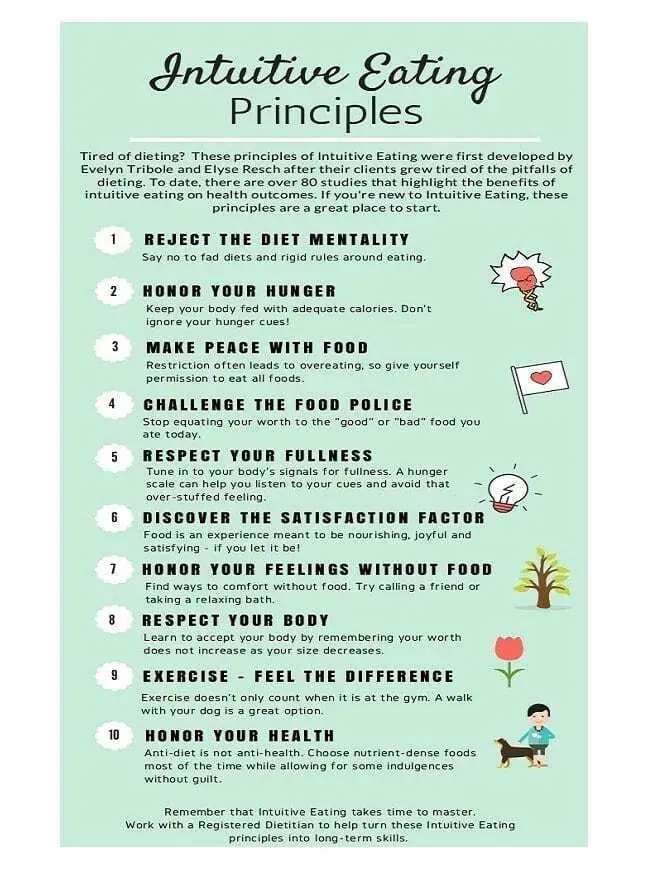
And I have applied the principles of intuitive eating to reduce my cravings for marijuana dramatically.
(If you do want to learn more about intuitive eating principles, here’s an excellent article)
Here’s the lesson:
I let myself mindfully smoke pretty much as much weed as I wanted to without a deadline to stop … for a month, I binged … but then my cravings stopped

Let me explain real quick:
I am allowing myself to have as much weed as I want.
Just the other day, I got back from vacation and wanted weed.
Yet.
Paradoxically, because I knew I could have weed any time I wanted …
I didn’t want it.
I was able to listen to my gut (not my head) …
And my gut didn’t want weed.
Not because I was on some anti-diet of weed.
No, diets don’t work. We know that already!
I’ve tried quitting weed dozens of times, and it always comes back.
But when I can smoke weed when I want to, then the desire goes down dramatically.