

You promised yourself you’d be good today.
But the moment came — the stress, the silence, the gnawing emptiness — and before you could stop it, the binge had happened. Again.
Now, you’re left with shame. Not just regret, but that deep, sinking feeling that something is wrong with you. That you’re broken. That you’ll never change.
But here’s the truth: you are not broken.
Shame after binge eating isn’t a sign of failure. It’s a signal. A message from your body and nervous system that something inside needs attention — not punishment.
This guide is for those tender moments when you feel lost in the aftermath of a binge. It will help you move forward with compassion, understand the emotional and biological roots of your behavior, and gently explore how to heal.
Curious about your relationship with food?
Take our free quiz for insight — not to diagnose, but to understand.
Why Shame After Binge Eating Feels So Overwhelming
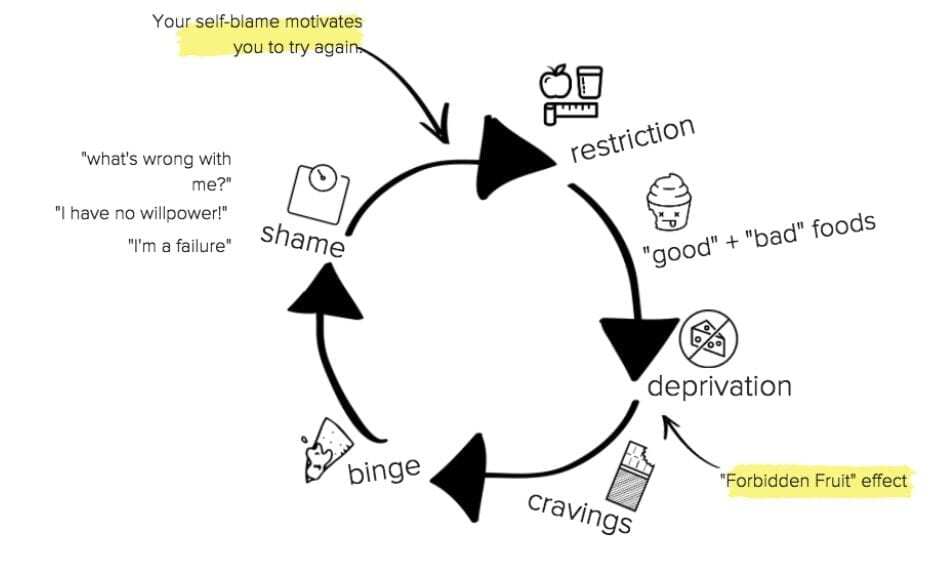
Shame isn’t just a feeling — it’s an experience in the body.
After a binge, your brain and nervous system often go into a protective spiral. You may shut down, dissociate, or fixate on thoughts like:
- “What is wrong with me?”
- “Why can’t I stop?”
- “I’ll never get better.”
This isn’t weakness. It’s a survival pattern.
The shame loop often begins in childhood, especially if you were taught that emotions, appetite, or body changes were wrong. If love felt conditional — on appearance, performance, or control — binge eating can emerge as both rebellion and relief. And shame follows right behind.
Research shows that shame is a powerful trigger for repeated binge episodes. A 2020 study in Eating Behaviors found that internalized shame predicted more frequent binge eating and lower self-compassion in individuals with disordered eating (Kelly & Carter, 2020).
Healing starts when we interrupt this loop — not with discipline, but with gentleness.
Step One: Pause and Offer Yourself Safety
Immediately after a binge, your system is usually overwhelmed.
Your stomach may hurt. Your heart may race. Your thoughts may spiral.
Before you do anything else, offer your body safety.
Try this:
- Place a hand over your heart or belly. Feel the warmth.
- Say, out loud or silently: “This is hard. And I’m still here.”
- Name your state: “I feel shut down,” “I feel panicked,” or “I feel numb.”
- Sit near a window or go outside, if possible — regulate with light and breath.
This small act of pausing is huge. It begins to shift you out of the shame-response and into presence.
Step Two: Understand the Function of the Binge
You didn’t binge because you’re weak.
You binged because, in that moment, your system believed it was the safest, fastest, or only way to cope.
Compassionate curiosity can help you explore:
- What happened before the binge?
- What emotion or sensation were you trying to escape or soothe?
- What do you remember wanting in that moment (connection, relief, numbness)?
Here’s a gentle journaling prompt:
“When I look back on this binge, I notice I was feeling __________. I needed __________. I tried to meet that need through food.”
This is not about blame. This is about learning to listen.
Want a structured way to track these moments with care?
Use our Mindful Meal Journal app to explore without judgment.
Step Three: Repair Without Punishment
Many people respond to a binge with restriction — skipping meals, punishing workouts, harsh self-talk. But this only deepens the cycle.
Restriction > Shame > Binge > Shame > Restriction.
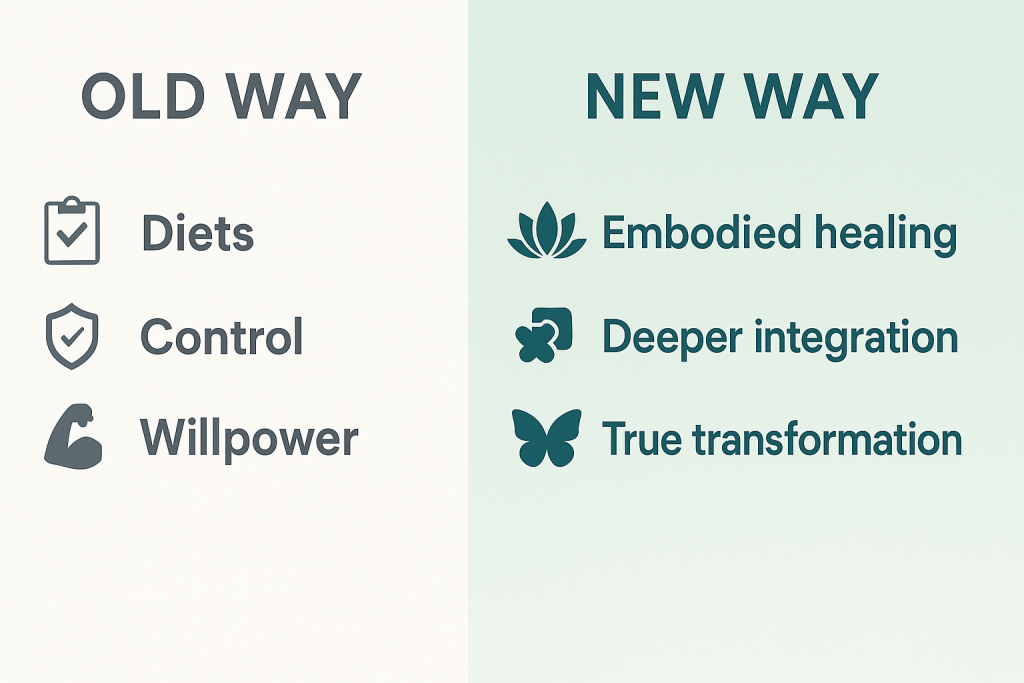
The way out isn’t more control. It’s repair.
Here’s how to repair with kindness:
- Eat your next meal — not your next perfect meal, just a meal.
- Drink water. Rest if you can.
- Name one thing you’re proud of today, even if it’s “I kept going.”
This creates a new pattern:
Binge > Compassion > Learning > Nourishment.
Step Four: Explore the Roots of Your Shame
To truly move forward, you must understand why you feel such intense shame around food and eating.
Some common roots:
- Cultural messages: Thin = good. Control = success.
- Family dynamics: “Clean your plate,” “Don’t eat too much,” “You’ll get fat.”
- Religious or moral overlays: Gluttony as sin, appetite as wrong.
- Trauma: If your body was objectified, judged, or hurt — food may now carry a burden it was never meant to hold.
These are not personal failings. These are cultural and relational imprints.
By recognizing them, you loosen their grip.
You might say:
“This shame doesn’t belong to me. It was taught to me. And I can learn something new.”
Step Five: Build Emotional Safety Beyond Food
Food often becomes the safest — or only — way to soothe, regulate, or feel something.
Part of recovery is creating new sources of emotional safety.
Try exploring:
- Touch: wrap in a blanket, hold a warm mug, press palms together
- Sound: calming playlists, nature sounds, voice notes from loved ones
- Movement: slow stretching, walking, swaying, rocking
- Expression: art, tears, voice, breath
These aren’t replacements for food. They’re companions. Over time, they widen your window of tolerance — so food doesn’t have to carry the whole weight.
Step Six: Reframe Your Story — You Are Becoming
Every time you move through shame with compassion, you rewrite your story.
It’s no longer: “I binged because I’m broken.”
It becomes: “I binged because I was overwhelmed. And I chose to meet that pain with kindness.”
You’re not just healing your relationship with food. You’re reclaiming your sense of worth. Your right to feel. Your right to be here, exactly as you are.
You Are Not Alone — And You Don’t Have to Do This Alone
Healing shame is relational. It requires spaces where you are seen, held, and never judged.
That’s why we created the Enlighten Eats course — a space where you can understand the layers of disordered eating through the lens of nervous system healing, emotional clarity, and spiritual depth.
You can also work 1:1 with a compassionate coach who gets it.
Or begin with something gentle:
No pressure. Just support.
Conclusion: What You Do After the Binge Is What Matters Most
Shame is heavy. But it’s not permanent.
You are allowed to feel bad after a binge — and still treat yourself with kindness. You are allowed to be both struggling and healing.
Recovery doesn’t mean never bingeing again. It means responding to each moment with more compassion, more understanding, and more trust in yourself.
You are worthy of that.
Start where you are. Begin with a breath. And if you’re ready, take the quiz to begin seeing yourself with new eyes.