


There’s a kind of hunger that isn’t in the stomach.
It pulses deeper — in the chest, in the throat, behind the eyes.
For years, I lived in the loop. Binge. Regret. Restrict. Repeat.
Some days I’d wake up hopeful, thinking today will be different. By nightfall, I was curled around a box of cookies, shame dripping heavier than the sugar.
No one knew how hard I was trying.
No one saw how food became a battleground between my mind and my body.
This is my story of healing — not because I’m “done” or “fixed,”
but because I finally stopped trying to earn my worth through control.
If you’re caught in your own cycle of binge eating, please know this:
You are not broken. And you’re not alone.
Curious about your relationship with food?
Our free quiz can gently offer insight into your unique experience.
What Binge Eating Really Felt Like For Me

On the outside, I looked okay.
Functioning. Smiling. Sometimes even praised for my “willpower” when I skipped lunch.
But the truth?
- I planned binges in secret.
- I promised myself, This is the last time.
- I felt powerless, ashamed, confused.
At night, I’d stand in the kitchen, hypnotized by the fridge light. I wasn’t even hungry. I just wanted something to numb the ache inside.
Looking back, it wasn’t about food at all.
It was about:
- Loneliness I didn’t know how to name
- Anxiety that made my skin buzz
- A nervous system stuck between freeze and fawn
I learned later that this kind of eating often emerges from a dysregulated body and a soul starved for safety. No diet could fix what was, at its core, a relational wound.
If this resonates — know that healing isn’t about “discipline.” It’s about coming home to yourself.
The Turning Point: When “Willpower” Finally Failed Me
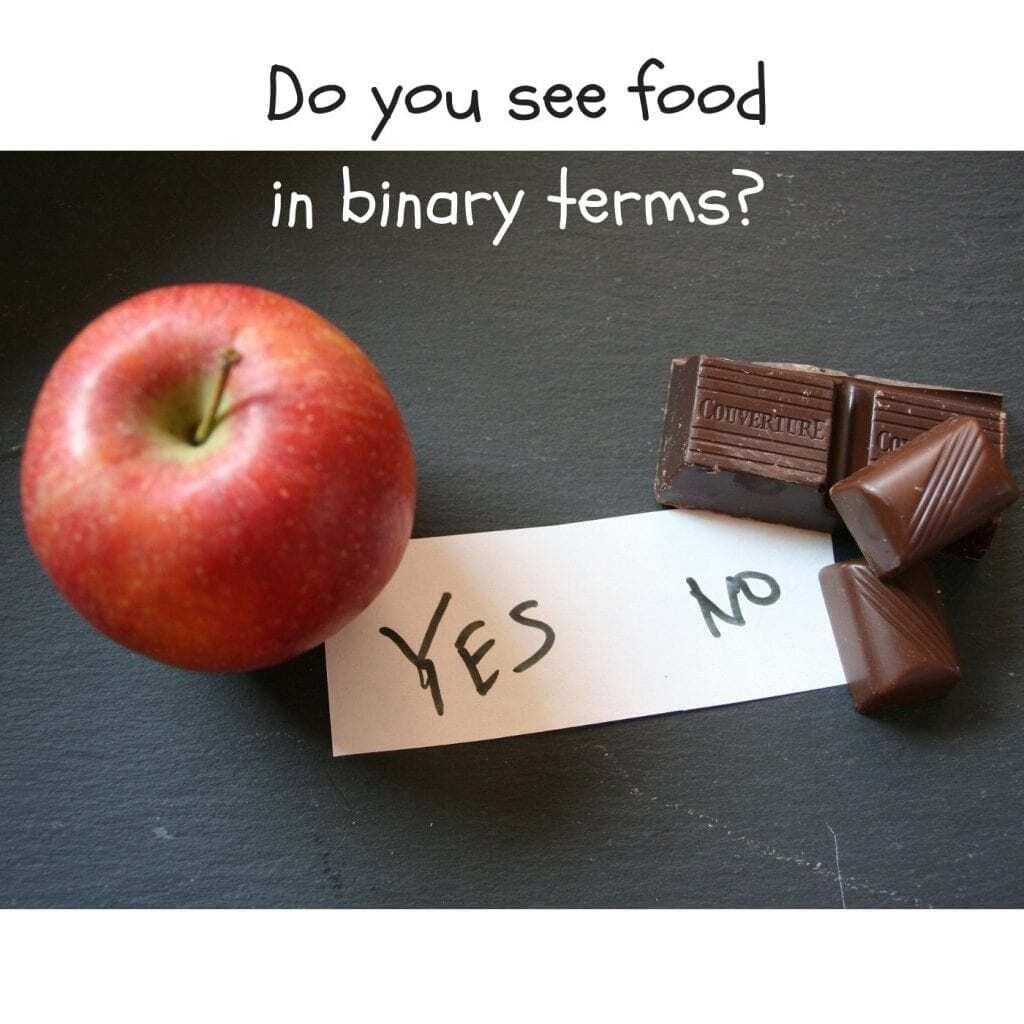
For years, I thought I just needed to try harder.
Track more. Fast longer. Be better.
But my binges kept getting worse.
The breaking point came quietly.
I had just finished a massive binge. My stomach hurt. My chest was tight. I looked in the mirror and whispered, What is wrong with you?
Something broke open.
Not in a dramatic way — but in a tired, surrendered way.
I realized this was not a food problem.
That was the moment I started to seek help, not punishment.
What Help Actually Looked Like (And What It Didn’t)
At first, I googled “how to stop binge eating.”
Most advice was trash. More control. More shame. More rigidity.
But then, I found something different.
I found:
- Gentle practices for mindful eating
- Language around nervous system regulation
- A framework that honored emotions, trauma, and unmet needs
I learned about Enlighten Eats, a course that didn’t offer a “quick fix,”
but instead mapped out the true stages of recovery — including somatic safety, emotional clarity, and sustainable nourishment.
If you’re curious, learn more about the course here. It changed everything for me.
I also started using a mindful meal journal.
It wasn’t about tracking calories.
It was about tracking feelings.
Slowly, I realized:
- I binged most when I felt disconnected
- I restricted most when I felt afraid
- My body was asking for care, not control
What I Wish I’d Known Earlier About Binge Eating
If I could speak to my past self, I’d tell her this:
- You are not broken — you are responding to a world that asked you to shrink.
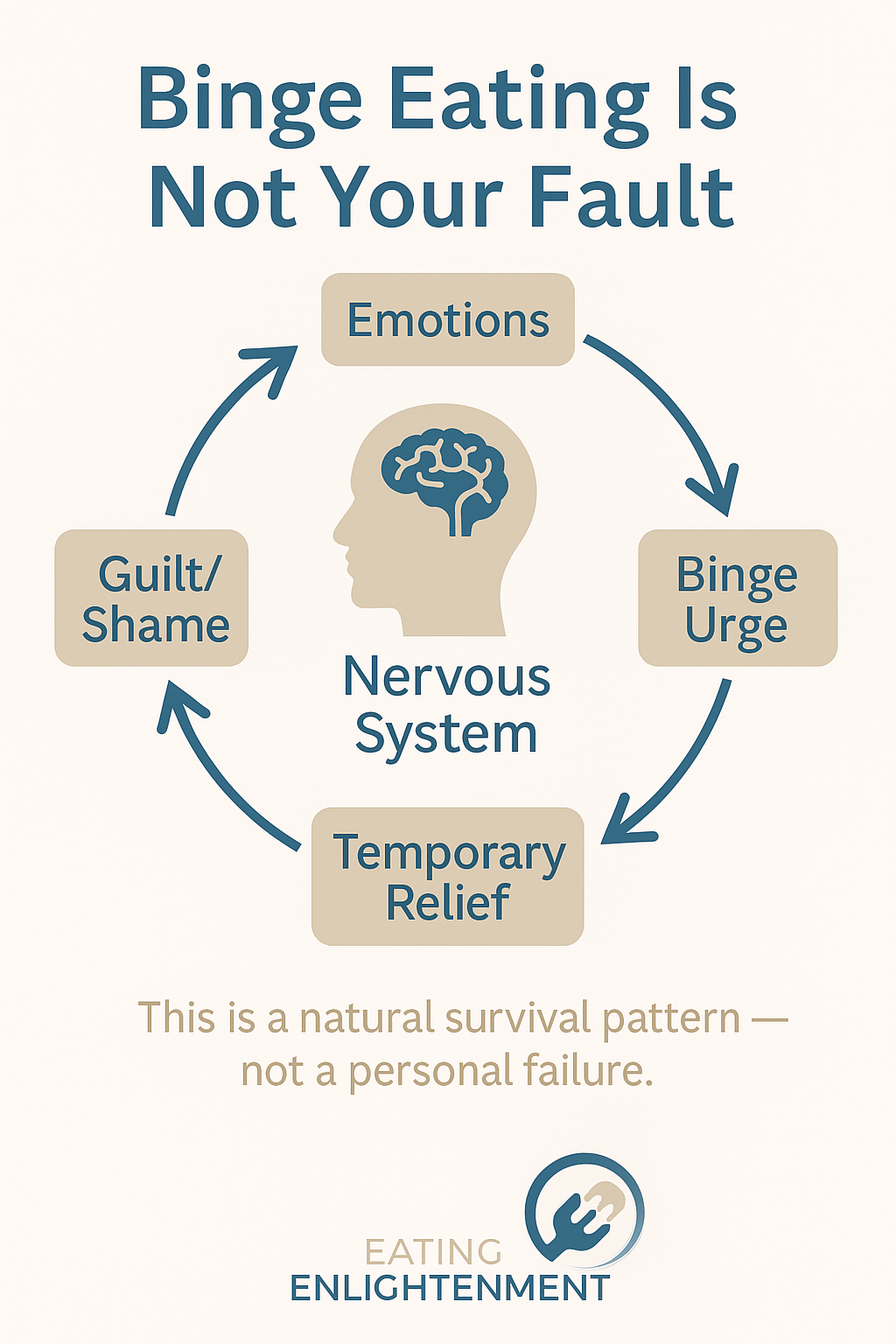
- Binge eating is not just about food — it’s about unmet emotional needs.
- Recovery isn’t linear — there will be hard days, and that’s okay.
- Your body isn’t the enemy — it’s been trying to protect you all along.
A 2023 review published in Appetite found that self-compassion interventions significantly reduced binge eating behaviors and improved emotional regulation in adults struggling with food issues (Kelly et al., 2023).
That study wasn’t news to me — it just put words to what I was slowly living.
The Role of Shame, Trauma, and the Nervous System
This part’s harder to write, but it matters.
Some of my patterns began in childhood —
when love felt conditional and food felt comforting.
I learned to be “the good kid.”
To suppress needs.
To make others comfortable at the expense of myself.
In that context, binge eating made sense.
My system didn’t know how to feel safe without food.
Not because I was weak.
Because I never learned how.
No one taught me that emotions come in waves,
that I could ride them — not drown in them.
No one taught me how to breathe through discomfort instead of eating it.
That’s why binge eating isn’t a character flaw.
It’s a brilliant adaptation in a world that never taught nervous system literacy.
Want to learn how to track hunger, fullness, and emotions with gentle structure?
Try our Mindful Meal Journal and scheduling app — it’s helped me more than any diet ever did.
How I Relate to Food Now: Imperfect, Real, Free
These days, I still have moments.
But I don’t binge anymore.
I listen. I pause. I nourish.
And when things feel hard — I reach out instead of shutting down.
Here’s what helped me stay on track:
- Coaching that focused on root causes, not food rules
- Daily journaling to connect with my emotions
- Learning how to co-regulate with safe people
- Letting go of the need to be perfect
If you’re seeking personalized support, you can explore 1:1 coaching options here. It’s not about fixing — it’s about finding yourself again.
Final Thoughts: Your Journey Matters, Too
If you’re reading this and your heart is pounding,
if you’re holding your breath hoping no one finds out —
please hear this:
You are not alone.
Your binge eating isn’t a failure.
It’s a language.
And it’s speaking of a hunger that deserves to be heard.
Healing isn’t a straight line.
But it is possible.
And you are already on your way — just by being here.
Ready to explore what’s underneath your relationship with food?
Start with our gentle, free quiz or learn more about Enlighten Eats — both are safe, kind places to begin.